Why Visual Clarity Can Save Lives: Designing for thinking under stress.
2 dic 2025
Mark Gibson
,
UK
Health Communication and Research Specialist
After the first assassination attempt in 2024, what we remember is that President Donald Trump had a very near miss and then defiantly shouted ‘Fight! Fight! Fight!’ with the American flag in the background. It is an iconic moment seared into all our brains. But that is not entirely how it happened. There was a moment between the shot and the brave defiance (whatever you may think of President Trump, that defiance was undeniably brave) where he said ‘let me get my shoe’ two or three times before regaining his composure. It was a small liminal moment, strangely mundane amid the chaos, that is a potent symbol of how the brain short-circuits under pressure. The fight-or-flight response scrambles rational thought. In the immediate aftermath of trauma, our minds prioritise incomplete, sometimes irrational ideas.
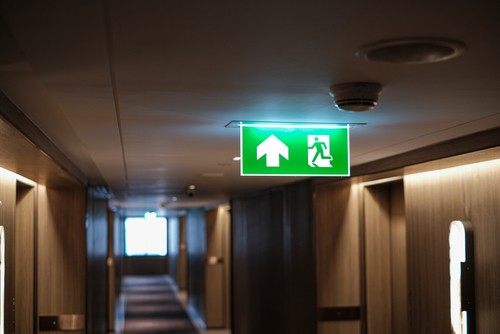
I’ve experienced this first-hand quite recently. During a hotel fire early one morning, I heard the alarm. I understood it was not a drill and I noted the half-panicked voices in the corridor outside my room. But instead of heading straight out, I focused on finding my socks and putting them on. Once out the room and despite my career-long interest in signs and wayfinding, I did not register the ubiquitous luminous green fire exit signs literally illuminating the way I needed to go. I took a wrong turn, then went down the wrong stairwell, backtracked and eventually found my way and I was the last one out of the building. It was a real fire but imagine if it was any more serious and I may not be here now. My brain had simply stopped functioning in a linear, purposeful way.
I am sure that everybody has had those occasions where you try to access something quickly on a smartphone. It might be showing a ticket or vaccine status on an app or making an emergency call. Even though we are all fluent with the interface, under pressure we flit between icons, open unrelated apps and we are momentarily unable to locate the most basic function, i.e. making a call. Or in lifts, when trying to hold the door open (⬅️➡️) for someone, we press the ➡️⬅️ ‘close’ button instead. The intent is correct, but the reaction is wrong. And, under pressure, this keeps happening. I can recall at least a dozen times where I have done this.
These anecdotes illustrate a universal truth: human cognition falters in high-stress environments. We might freeze, fumble or fixate on the wrong things. And when this happens, good design of interfaces and the icons within them can mean the difference between a momentary setback and a fatal delay.
In moments of crisis, even simple tasks like phoning for help can feel insurmountable. Our cognitive loads spike, adrenaline floods our systems and tasks that we have done a thousand times suddenly become confusing.
The Psychology of Panic
In dangerous and stressful situations, our amygdala, the part of the brain responsible for emotional processing, overrides the prefrontal cortex, which governs reason and planning. This leads to a tunnel vision effect, memory loss and poor motor coordination. Tasks that feel automatic in normal conditions become daunting or inaccessible.
Imagine you are trying to evacuate a building. You are disoriented, adrenaline is surging and the lights are low. You see a green icon that is unlabelled. It follows flat design and is indistinct. Is it an exit? A button? Something decorative? In these moments, you need clarity, not an invitation to conjecture.
Design needs to account for this. It cannot assume that users are in a calm and composed state of mind and that they are tech-literate. It must anticipate panic, fatigue, confusion – and compensate for them. (Side note: the interesting aspect of this is how to UX test this.)
Where Design Often Fails
Too often, visual systems in crisis tools are designed like they are meant for the Museum of Modern Art (MoMA): minimal, elegant and unlabelled. But minimalism does not help when someone is operating at a fraction of their normal mental capacity. When people misread flat, context-less icons, it is not user error. It is a mismatch between the design of the visuals and the brain state it is meant to serve. This applies as much to static visuals as it does to electronic ones.
There have been high-profile failures that illustrate this. For example, many COVID-19 symptom tracking apps used abstract icons with no labels or motion cues. Many users exited the systems early or skipped key steps because they could not tell what to tap. In another case, an emergency evacuation app relied on colour-coded flat icons to denote exits, danger zones and safe zones. In tests, users consistently misread or ignored them, particularly in low-light conditions or under stress. In both cases, the underlying technology worked, but the interface did not.
Clarity Under Pressure
So, what does effective design look like when it needs to stand up to stress, fatigue, fear or time pressure or often all of these happening to the user simultaneously? It means going back to the very fundamentals of cognition and perception:
1. Redundancy of Signal
o Use shape, colour, label and animation together.
o Don’t just show a visual, like a red circle. Label it.
o Pair motion, such as a pulsing icon, with audio or haptic feedback.
2. Familiarity Over Novelty
o Use well-known and familiar metaphors. A phone should look like a phone. A cross should signal medical help.
o Do not make users guess. Even clever design is too clever if misunderstood.
3. Emotionally Grounded Design
o Warm colours and rounded shapes can reduce anxiety.
o Animations like ripple effects offer reassurances that an action has been registered.
4. Inclusive Accessibility
o Design with non-native speakers, children, older adults and people with disabilities in mind.
o Do not rely on colour alone, but use contrast, shape and position.
5. Affirmation and Feedback
o Every action should offer immediate, unambiguous feedback.
o Buttons when tapped should light up, vibrate and confirm.
Clarity is a Life Skill. So, Design to Make It Easy.
In a crisis, a user may be barefoot, foggy-minded, in shock or searching for a loved one. They will not care about elegant minimalist design or be in awe at clever abstractions that they have to decode. They are using it in a critical situation. Survival may even depend on successful use of the app. The interface must meet them in that emergency situation.
The design needs to respect human psychology in crisis. The icons, buttons and navigations need to be designed as if someone’s life depends on it.
Thank you for reading,
Mark Gibson
Leeds, United Kingdom, June 2025
Originally written in
English