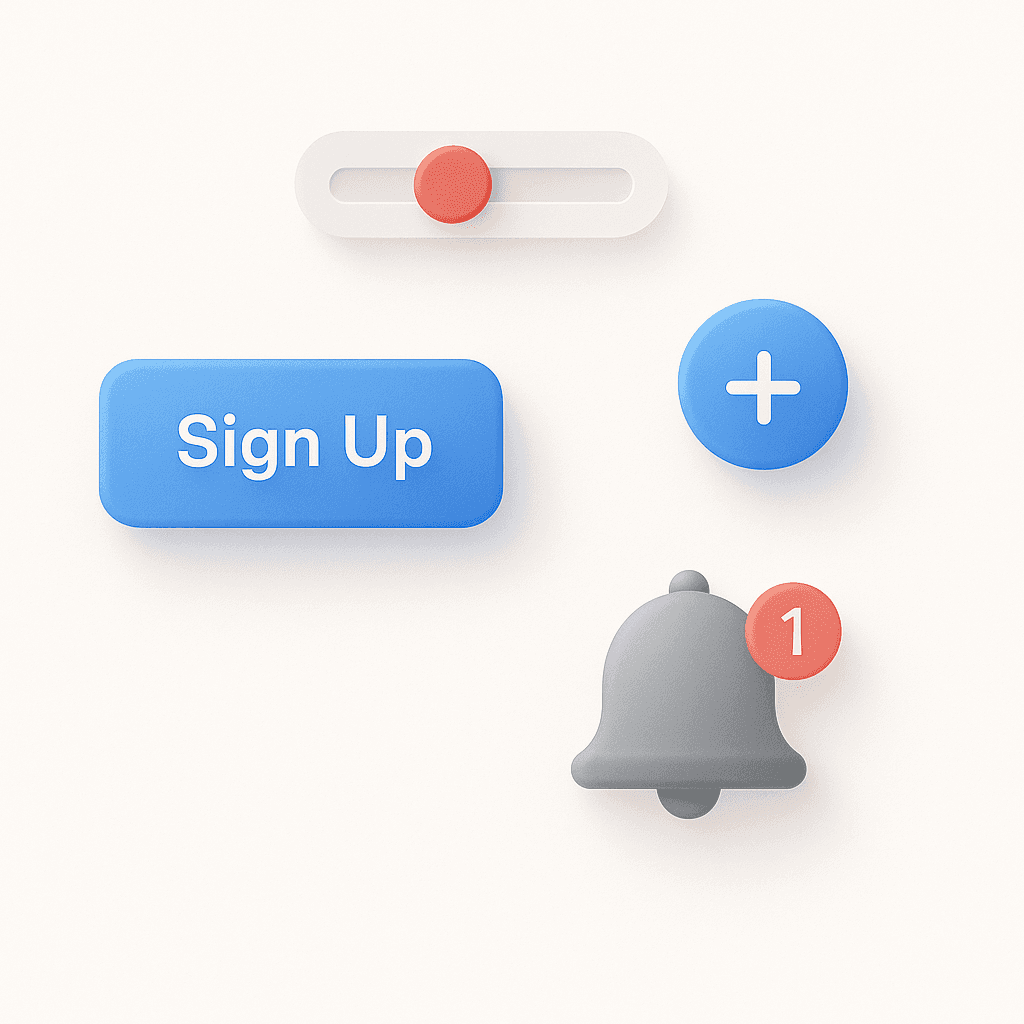
The Case for Semi-Skeuomorphic Design
2 dic 2025
Mark Gibson
,
UK
Health Communication and Research Specialist
In previous articles, we discussed how flat design brought speed and simplicity to the digital experience, but it also introduced limitations, especially in clarity, emotion and accessibility. This article argues that the future of iconography is not flat, but thoughtful and this could mean a bridging of flat and skeuomorphic design approaches.
Semi-skeuomorphic design is a modern, flexible approach that blends the efficiency of minimalism (flat) with the usability of realism (skeuomorphic). This is sometimes called Flat 2.0 or tactile minimalism. It is a hybrid design approach that combines the core principles of flat design with touches of realism and dimensionality to help affordance, clarity and warmth.
This typically include icons that have:
· Subtle shadows to indicate elevation or interactivity.
· Gentle gradients to hint at surface or light.
· Motion to reinforce hierarchy and action.
· Rounded corners, layering, blur, all of which contribute to softness and emotional tone.
· Icons that are simple but suggest metaphor or physicality.
The purpose of this is not to mimic real objects, as in early skeuomorphic design, but to evoke a sense of touch, place or action without the clutter of early apps.
Why the middle ground is necessary
The early excesses of skeuomorphism were addressed and fixed by flat design. However, as we have discussed in previous articles, it went too far in the opposite direction. Total flat design assumes too much about a user’s visual literacy, the cultural understanding of symbolic forms and confidence in using UI without visual guidance. In short, it assumed that everybody was an expert user.
Semi-skeuomorphism brings back:
· Affordances: Buttons that look pressable again.
· Hierarchy: Layers that suggest depth and importance.
· Emotion: A visual tone that feels more human.
These are crucial for:
· Healthcare interfaces
· Education apps
· Young and older users alike
· First-time users
· Accessibility-focused systems,
· Emotionally sensitive platforms, such as eCOAs, eDiaries, therapy, end-of-life care.
Where Semi-skeuomorphism is already happening
Some of the biggest platforms have already embraced this evolution:
· Google’s Material Design introduced the idea of elevation, using shadows and motion to communicate hierarchy and interactivity. Flat design cards ‘lift’ when you tap them and the transitions feel tactile.
· Apple Interface Design, post-iOS 13 reintroduced soft gradients, depth via blue, such as Control Centre overlays and rounded buttons and hints of translucency. In other words, still minimalist but recognisably touchable.
· Tools like Slack, Notion, Monday, Stripe use simple shapes, but they feel soft, polished and intentional. For example, a tooltip may pop up with a shadow or icons that respond to hovers. When you interact with them, it feels like something is actionable.
Principles of Semi-Skeuomorphic Design
1. Depth, Not Decoration: layering and elevation suggest structure, buttons should feel clickable and cards should feel separate from the background.
2. Motion as Feedback: Microinteractions help users learn: a button that ripples, a hover that lifts, a swipe animation, that celebration visual when you have completed a task on Monday.com. Motion can do what static visuals cannot.
3. Tone Matters: A slightly rounded button signals ‘friendliness’. A flat rectangular button says ‘corporate’. The subtle styling of visuals sets the emotional tone of a digital space.
4. Clarity through Contrast: Shadows and gradients help users tell elements apart from one another, especially when colour is limited, such as accessibility themes or dark mode.
5. Familiar, but not Literal: A semi-skeuomorphic calendar icon does not need to look like a paper diary, but it should feel distinct, recognisable, structured and something you can interact with.
What are the benefits of semi-skeuomorphism?
· Better navigation where users know what to press, swipe and tap.
· A warmer tone encourages trust in health and education interfaces.
· Visual clarity is important for users with low vision and experiencing screen fatigue.
· Reduces cognitive load where intuitive depth guides focus.
· Bridges generations that helps older and younger users equally.
· Enhanced cross-cultural usability where realism supports broader interpretation.
Designing with Empathy
Semi-skeuomorphic design promotes designing with empathy over aesthetics. An early skeuomorphic icon says, “This will be familiar to you”, whereas a flat icon conveyed “Just figure it out”. A semi-skeuomorphic icon says, “We thought about how this feels”. This is critical in crisis or emotionally sensitive situations, especially in health apps, where those small visual decisions make a big difference in how people experience trust, clarity and control.
Semi-Skeuomorphic might work best in the following scenarios:
· Onboarding for new users where visual cues support learning.
· Health and wellness apps where it is crucial to build emotional confidence.
· Apps related to Crisis, Emergency and Risk Communication (CERC) initiatives where there is no scope or time for ambiguity or lack of clarity.
· Legal and consent forms where semi-skeuomorphic adds structure without clutter.
· Accessibility-focused interfaces where semi-skeuomorphic icons can enhance focus, affordance and clarity.
· Children’s educational tools where visuals need to be tactile, friendly and engaging.
· Public kiosks and touchscreens where tap targets and hierarchy need to be obvious.
When it should not be used
There are places where flat design is preferred. These include:
· Developer tools
· Data-heavy dashboards
· Brand sites that are deliberately minimalist
· Text-dominant apps.
However, if the user experience would benefit from tone, guidance or tactility, then developers could then lean into semi-skeuomorphism.
A More Human Visual Language
Design does not have to be a binary between realism and minimalism. The solution is dependent on the context of use. At the earliest stage of development, the needs to the user, the context and the aesthetic intent of the app all need to be carefully considered.
Semi-skeuomorphic design is an evolution in the development of visuals. It combines clarity with comfort and structure with emotional resonance. It allows developers to create digital spaces that are usable as well as welcoming – the two do not have to cancel each other out.
Today, screens mediate everything from work to education and entertainment to physical and mental health, the way things look still says a lot about how they make people feel.
Thank you for reading,
Mark Gibson
Sunderland, United Kingdom, June 2025
Originally written in
English