The Cognitive Burden Simulator: Shared-Stem Frequency Items
6 ene 2026
UK
,
Spain
In this article, we examine the cognitive burden of a shared-stem frequency item set, a matrix-style design often used in Clinical Outcome Assessments and Patient-Reported Outcome (PRO) measure:
Thinking about the past four weeks, consider how your health condition has affected different aspects of your daily life, including physical activity, cognitive function, emotional well-being, and social interactions.
Please select the option that best reflects your experience for each statement:
Never | Rarely | Sometimes | Often | Always | |
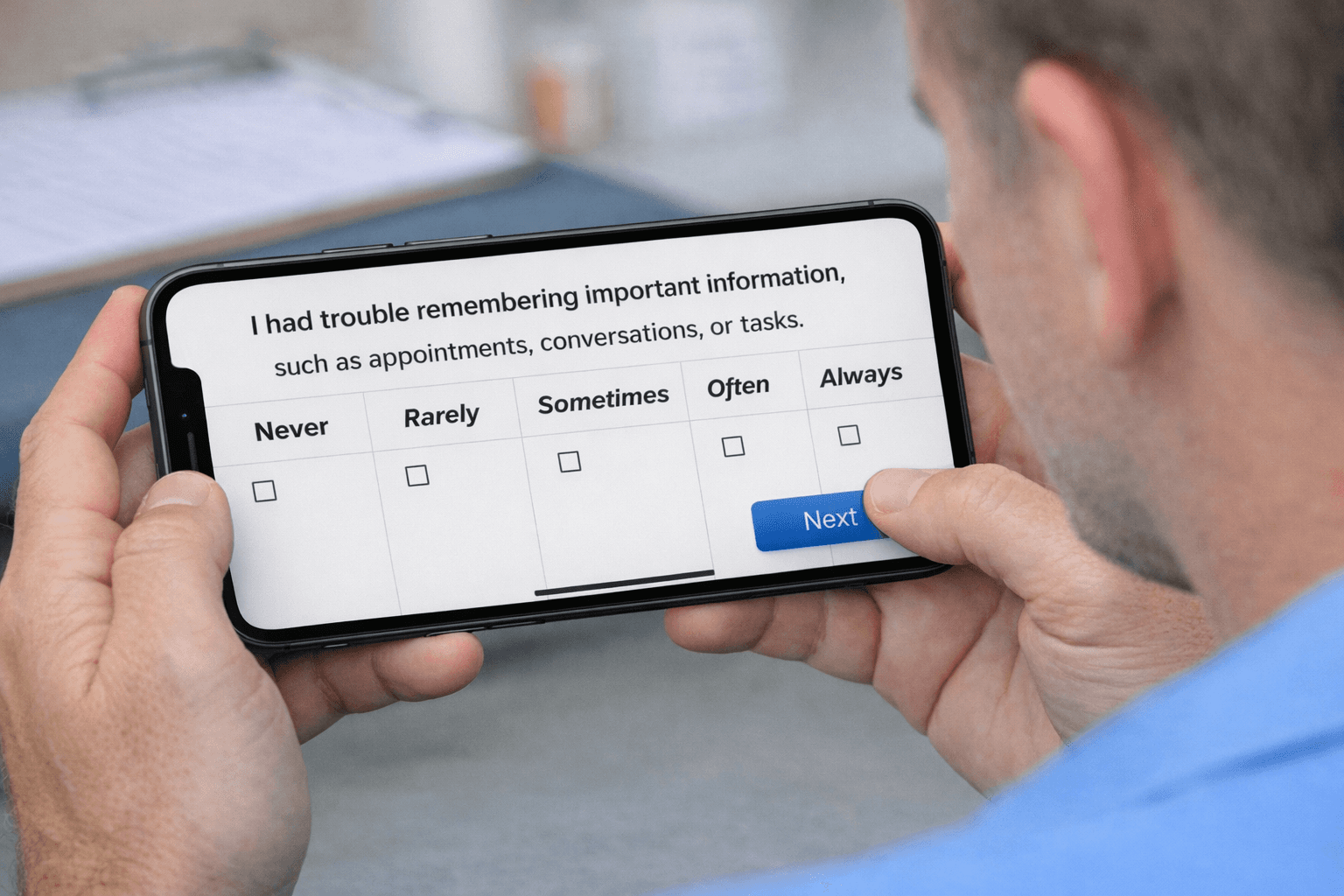
I had trouble remembering important information, such as appointments, conversations, or tasks. | ☐ | ☐ | ☐ | ☐ | ☐ |
I needed to take more breaks or rest periods than usual due to fatigue or lack of energy. | ☐ | ☐ | ☐ | ☐ | ☐ |
I found it difficult to concentrate on tasks such as reading, watching TV, or following conversations. | ☐ | ☐ | ☐ | ☐ | ☐ |
At first glance, this looks like a patient-friendly (relatively speaking) way to reduce repetition and streamline the questionnaire. Instead of rephrasing the same timeframe and instructions for each symptom, the stem is given once and is applied across several items. But beneath this efficiency lies a hidden challenge: patients must hold the shared stem in working memory while answering multiple questions, a demand that can easily exceed Cowan’s realistic 4 ± 1 limit. The CBS models help reveal how this format shift the burden from reading effort to memory effort, with consequences for accuracy, fatigue and the reliability of patient-reported data.
What Makes This Item Easy
1. Efficiency of presentation
The stem is given once, so patients do not need to re-read the timeframe and instructions for each item.
This saves time and reduces reading fatigue compared to repeating the full question three times.
2. Consistent response scale
The same five-point frequency scale (Never to Always) applies across all items.
Familiarity with the scale after the first item makes subsequent responses faster and more intuitive.
3. Everyday concepts
Phrases such as “trouble remembering important information”, “take more breaks due to fatigue” and “difficult to concentrate” use plain, relatable language.
Little medical jargon or technical terms, although the general feel of the item is towards the higher-register end of the stylistic spectrum.
What Makes This Item Difficult
1. Working memory demand
Patients must hold the stem in mind while answering multiple items. For example, when responding to “I needed to take more breaks due to fatigue”, they must remember that the context is “thinking about the past four weeks” and “how your health condition has affected daily life.”
This requires juggling at least 2-3 concepts before even processing the new item.
2. Multi-domain integration
The stem references four domains: physical activity, cognitive function, emotional well-being, social interactions.
Each sub-item maps onto one or more of these domains, requiring the respondent to integrate across different aspects of experience.
3. Serial fatigue
Even though the stem is only read once, patients must apply it repeatedly.
Each new item involves recall + scale mapping, which accumulates over the set.
By the third or fourth sub-item, attention and accuracy may decline.
4. Risk of misalignment
Some patients may partially “forget” or misremember the stem as they move through the items. For example, they might answer “trouble concentrating” in general terms, forgetting that the instruction tied it specifically to “how your health condition affected daily life.”
5. Cowan’s limit exceeded
The shared stem itself contains multiple elements: timeframe, health condition, four life domains.
Holding this context while evaluating sub-items adds at least 4-5 active chunks to working memory.
This exceeds Cowan’s realistic limit, even before emotional salience, e.g. admitting concentration problems, is factored in.
Key Point:
Shared-stem items are efficient on the page, in terms of COA ‘real estate’, but mentally inefficient in practice. They reduce visible repetition but increase invisible memory strain shifting the burden from reading effort to recall and context maintenance.
CBS Breakdown Table
Level | Component Type | Text | Notes |
Root | Shared Stem | Thinking about the past four weeks, consider how your health condition has affected different aspects of your daily life, including physical activity, cognitive function, emotional well-being, and social interactions. | Applies to all sub-items; must be held in working memory |
1 | Timeframe | Thinking about the past four weeks | Recall anchor |
1 | Condition | Your health condition | Context reference |
1 | Instruction | Consider how it has affected daily life | Broad frame |
2 | Domains | Physical activity / Cognitive function / Emotional well-being / Social interactions | Multi-domain context (4 concepts at once) |
Root (Sub-item 1) | Question | I had trouble remembering important information, such as appointments, conversations, or tasks. | Memory-related difficulty |
1 | Response Options | Never / Rarely / Sometimes / Often / Always | 5-point frequency scale |
Root (Sub-item 2) | Question | I needed to take more breaks or rest periods than usual due to fatigue or lack of energy. | Fatigue-related difficulty |
1 | Response Options | Never / Rarely / Sometimes / Often / Always | Same scale, repeated |
Root (Sub-item 3) | Question | I found it difficult to concentrate on tasks such as reading, watching TV, or following conversations. | Attention-related difficulty |
1 | Response Options | Never / Rarely / Sometimes / Often / Always | Same scale, repeated |
Simulation of Shared-Stem Item: CBS + Nine Circles of Burden Table
Circle | Burden Layer | Mindmap / CBS Node | Patient Thought Simulation |
0 – CBS Core | Parsing the stem | Shared stem: “Thinking about the past four weeks, consider how your health condition has affected…” | “Okay, I need to read this long instruction… four weeks, health condition, daily life…” |
1 – Working Memory Limits | Holding the stem in mind | Timeframe, condition, daily life, domains (physical, cognitive, emotional, social) | “That’s already a lot to keep in mind… I must remember: past 4 weeks, my health, daily life impact…” |
2 – Visual Processing | Scanning & alignment | Eye movement, tracking lines, aligning responses to the right row | “All these items look similar in a grid… I need to track rows carefully so I don’t misalign responses.” |
3 – Linguistic / Cultural | Interpretation | Parsing terms like ‘daily life,’ ‘conversations,’ ‘social interactions’ | “What exactly counts as ‘social interactions’? Does ‘conversations’ mean family or at work?” |
4 – Delivery Mechanism | Paper vs. digital | Boxes on a paper form vs. scrolling on ePRO | “Small boxes on paper… easy to lose my place. On a screen, I have to scroll back to recall the stem.” |
5 – Contextual Stressors | Condition + environment | Patient’s state: pain, fatigue, anxiety during survey | “I’m tired and not sure I can focus right now… These questions feel like they want me to prove how unwell I am.” |
6 – Wording Ambiguity | Scale fuzziness | Anchors: Never, Rarely, Sometimes, Often, Always | “‘Often’ vs. ‘Sometimes’ — which fits if it happens every few days? What’s the difference between ‘fatigue’ and ‘lack of energy’?” |
7 – Presentation Conventions | Layout conventions | Uniform response rows, repetitive scales | “All rows look the same — did I just tick the wrong one? Do I answer for every day, or just the worst days?” |
8 – Emotional Salience | Sensitive content | Statements about memory, fatigue, concentration | “I don’t like admitting I forget appointments… it feels like I’m exposing my weaknesses.” |
9 – Overload / Collapse | Coping heuristic | Default to satisficing or heuristic answering | “This is too much — I’ll just pick ‘Sometimes’ for most of them…” |
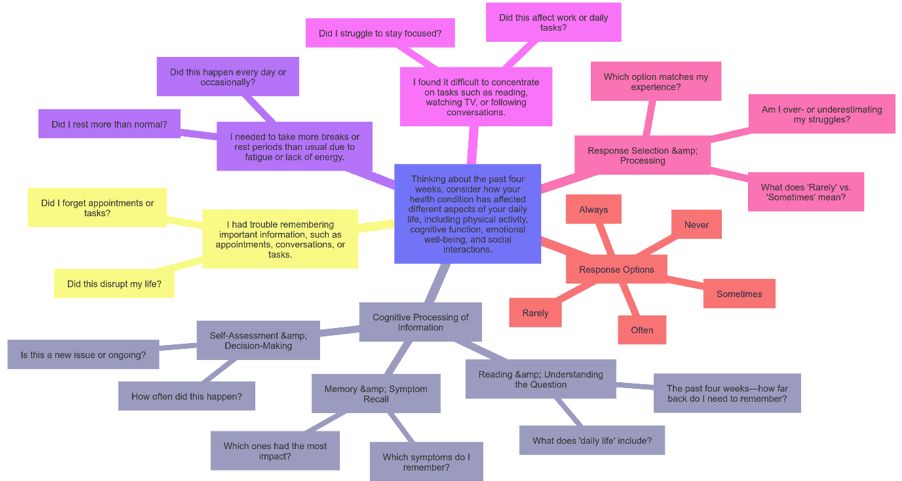
Visual Map
What the Map Shows
Shared context: Patients must keep the stem (timeframe + health condition + four domains) in working memory while moving through each sub-item.
Serial processing: Each sub-item requires recall, leading to judgement, leading to mapping to the same 5-point scale.
Accumulated burden: Even though each sub-item seems simple, the stem multiplies the load because it must be applied repeatedly.
Cowan exceeded: The stem alone has 4-5 active chunks; combined with each sub-item, the task regularly pushes patients beyond Cowan’s capacity.
What the Simulation Shows
Table 1: Nine Circles of Burden (Overview)
Circle | Description | Cognitive / Psychological Effect |
Circle 0 – CBS Core | Baseline parsing of the question | Even “simple” items require parsing timeframe, condition, and life domain simultaneously. |
Circle 1 – Working Memory (WM) Limits | Holding the question stem and task in mind | Quickly approaches or exceeds Cowan’s 4 ± 1 chunks. |
Circle 2 – Visual / Layout Friction | Scanning text, options, or response formats | Adds attentional load before content is even processed. |
Circle 3 – Scale Mapping | Mapping experience onto response options | Requires abstraction, averaging, and fuzzy category judgment. |
Circle 4 – Recall & Aggregation | Remembering events over time | Forces reconstruction rather than retrieval. |
Circle 5 – Attribution Complexity | Linking symptoms to causes | Introduces ambiguity and reasoning overhead. |
Circle 6 – Cross-Domain Integration | Weighing multiple domains together | Requires synthesis and prioritisation across concepts. |
Circle 7 – Repetition / Accumulation | Sustained answering across many items | Load compounds over time; fatigue sets in. |
Circle 8 – Emotional Salience | Stigma, threat, self-presentation | Increases avoidance, distortion, or defensive responding. |
Circle 9 – Collapse | Overload threshold | Heuristic responding, satisficing, or item skipping undermines data quality. |
Table 2: Nine Circles of Burden — Item Type Comparison
Item Type | Example | Circles Activated | Cognitive Burden Profile |
Binary (Yes / No) | “In the past week, did you experience any pain?” | 0–2 | Parsing + minimal WM + visual scan. ~4 chunks → near Cowan’s limit but usually manageable. |
Simple Frequency | “In the past month, how often did you feel anxious about your health?” | 0–3 | Adds recall and scale mapping. ~5–6 chunks → at or just beyond WM limits. |
Complex Frequency | “In the past month, how often did you experience involuntary, distressing mental imagery (nightmares/flashbacks) linked to trauma?” | 0–5, 8 | Stem + examples + attribution + emotional salience. ~6–7 chunks → overloaded and emotionally taxing. |
Global Evaluative | “How would you rate your overall quality of life, considering physical symptoms and emotional well-being?” | 0–6, 8 | Abstract synthesis across domains with causal reasoning. ~7–9 chunks → high overload risk. |
Checklist (Multi-select) | “Which emotional effects have you experienced? Select all that apply.” | 0–4, 6–7 | Recognition eases recall, but scanning overlap + stigma increases strain. ~6–7 chunks. |
Descriptor-based Ordinal | “Rate 19 pain descriptors on a 0–4 scale.” | 0–7, 8–9 | Repeated recognition + scaling under emotional load. ~8–10 sustained chunks → near-inevitable fatigue and collapse. |
Ranking Task | “Select up to 3 symptoms and rank them by impact.” | 0–6, 8 | Selection + comparison + prioritisation across domains. ~7–8 chunks → very high strain. |
Shared-Stem Frequency | “Thinking about the past four weeks… rate memory, fatigue, concentration.” | 0–7, 8–9 | Stem alone consumes 4–5 chunks; repeated application overloads WM → heuristic responding (“Sometimes” for all). |
What We Learn
Binary items: deceptively simple, but already at Cowan’s ceiling.
Simple frequency: adds recall + fuzzy scaling → slightly beyond limit.
Complex frequency & global evaluative: move into abstraction and emotional salience → high burden.
Checklist: easier in recall terms (recognition), but scanning + overlaps + stigma still overload WM.
Descriptor-based: extreme burden — serial processing across 19 descriptors leads to Circle 9 collapse.
Ranking: unique comparative burden — patients must prioritise across domains, straining WM.
Shared-stem: efficient on paper but inefficient in cognition. It externalises repetition but internalises memory strain, activating almost all circles, including overload/collapse.
Thank you for reading,
Mark Gibson, Madrid, Spain
Nur Ferrante Morales, Ávila, Spain
September 2025
Originally written in
English