The Cognitive Burden Simulator: Checklist, Multi-Select PRO Items
24 dic 2025
UK
,
Spain
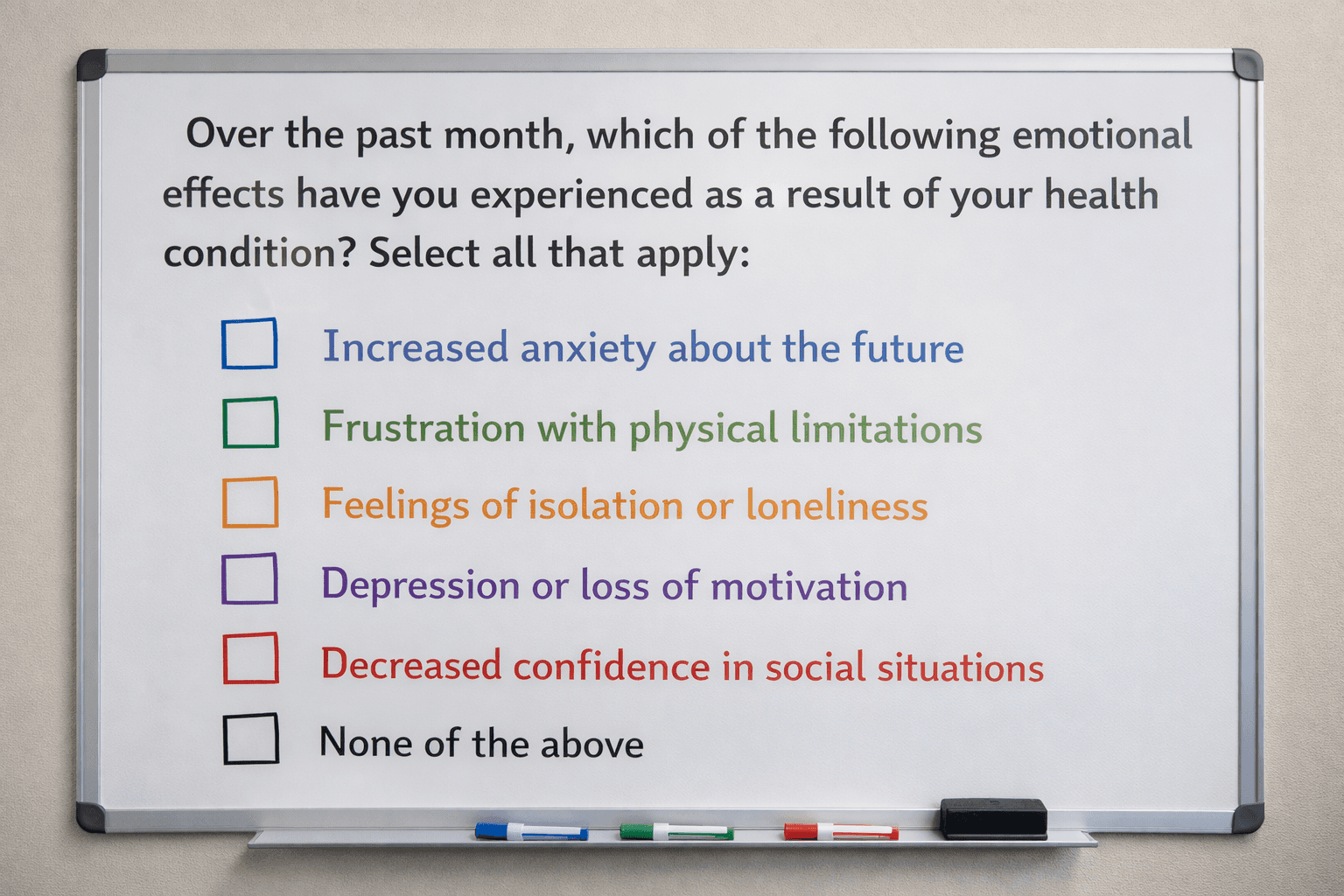
Having examined binary questions and frequency-type items, we now turn to another common format in patient-reported outcomes: the checklist or multi-select item. For example:
“Over the past month, which of the following emotional effects have you experienced as a result of your health condition? Select all that apply:
☐ Increased anxiety about the future
☐ Frustration with physical limitations
☐ Feelings of isolation or loneliness
☐ Depression or loss of motivation
☐ Decreased confidence in social situations
☐ None of the above.”
Here, the respondent is no longer confined to a ‘yes/no’ decision or to mapping experience onto a single ordinal scale. Instead, they are presented with a menu of options and asked to indicate all that apply. On the surface, it feels like the simplest of tasks – ticking boxes – yet it represents a significant shift in cognitive processing. The burden moves from recall to recognition but new challenges emerge: scanning through multiple descriptors, evaluating overlap and attributing experiences specifically to health rather than life more broadly.
What Is Easy About This Item
1. Recognition rather than recall
Patients don’t have to generate answers from memory but they simply need to scan a list and tick the ones that resonate. Recognition is less cognitively demanding than free recall.
2. Familiar, plain-language descriptors
Terms like anxiety, frustration, isolation, depression, confidence are everyday words. The item avoids technical jargon.
3. Clear timeframe
“Over the past month” provides a specific period, helping to anchor recall.
4. Flexibility of multiple responses
Patients are not forced into a single choice; they can select several experiences. This reduces the risk of “forced fit” answers.
5. Inclusive catch-all option
“None of the above” ensures the item does not exclude patients who did not experience any listed effect.
What is Difficult
1. Scanning and working memory load
Patients must read, hold and compare multiple options at once. This taxes working memory, especially if they feel several might apply simultaneously.
2. Overlapping or broad categories
‘Depression’ or ‘loss of motivation’ can overlap with ‘feelings of isolation or loneliness’. Patients may hesitate about double-counting or feel unsure which best fits.
3. Attribution challenge
The item requires experiences to be linked specifically to the health condition, not to life in general. That distinction is cognitively and emotionally subtle.
4. Aggregation over time
Patients must consider the entire past month, not just recent or salient experiences. Memory biases, such as recency, salience and current mood, can distort responses.
5. Emotional discomfort
Endorsing terms like depression or isolation can be sensitive, raining stigma concerns or avoidance.
6. "Tick box fatigue”
In a longer questionnaire with many similar items, the checklist format can lead to mechanical responding or missed selections.
Summary
This checklist item is “easy” in that it provides recognition-based choices in plain language with a clear timeframe. But it is “difficult” because it requires scanning multiple option, managing overlap, attributing emotions to health rather than life and aggregating experiences over a month. For some, the sensitivity of emotional terms adds and extra layer of burden.
CBS Breakdown Table
Level | Component Type | Text | Notes |
Root | Sentence | Over the past month, which of the following emotional effects have you experienced as a result of your health condition? Select all that apply. | Full item |
1 | Prepositional Phrase | Over the past month | Timeframe (anchors recall to 30 days) |
2 | Preposition | Over | Introduces timeframe |
2 | Noun Phrase | The past month | Object of preposition |
1 | Main Clause | Which of the following emotional effects have you experienced as a result of your health condition? | Core question |
2 | Interrogative Phrase | Which of the following emotional effects | Recognition demand (scanning a list) |
2 | Verb Phrase | Have you experienced as a result of your health condition | Predicate + attribution requirement |
3 | Auxiliary Verb | Have | Question structure |
3 | Subject | You | Respondent |
3 | Verb | Experienced | Main action |
3 | Prepositional Phrase | As a result of your health condition | Attribution requirement |
1 | Instruction | Select all that apply | Allows multi-response (branching paths) |
1 | Response Options | Checklist of emotional effects | Recognition-based categories |
2 | Option 1 | Increased anxiety about the future | Emotional state descriptor |
2 | Option 2 | Frustration with physical limitations | Emotional state descriptor |
2 | Option 3 | Feelings of isolation or loneliness | Emotional state descriptor |
2 | Option 4 | Depression or loss of motivation | Emotional state descriptor (overlaps with others) |
2 | Option 5 | Decreased confidence in social situations | Emotional state descriptor |
2 | Option 6 | None of the above | Catch-all / negative option |
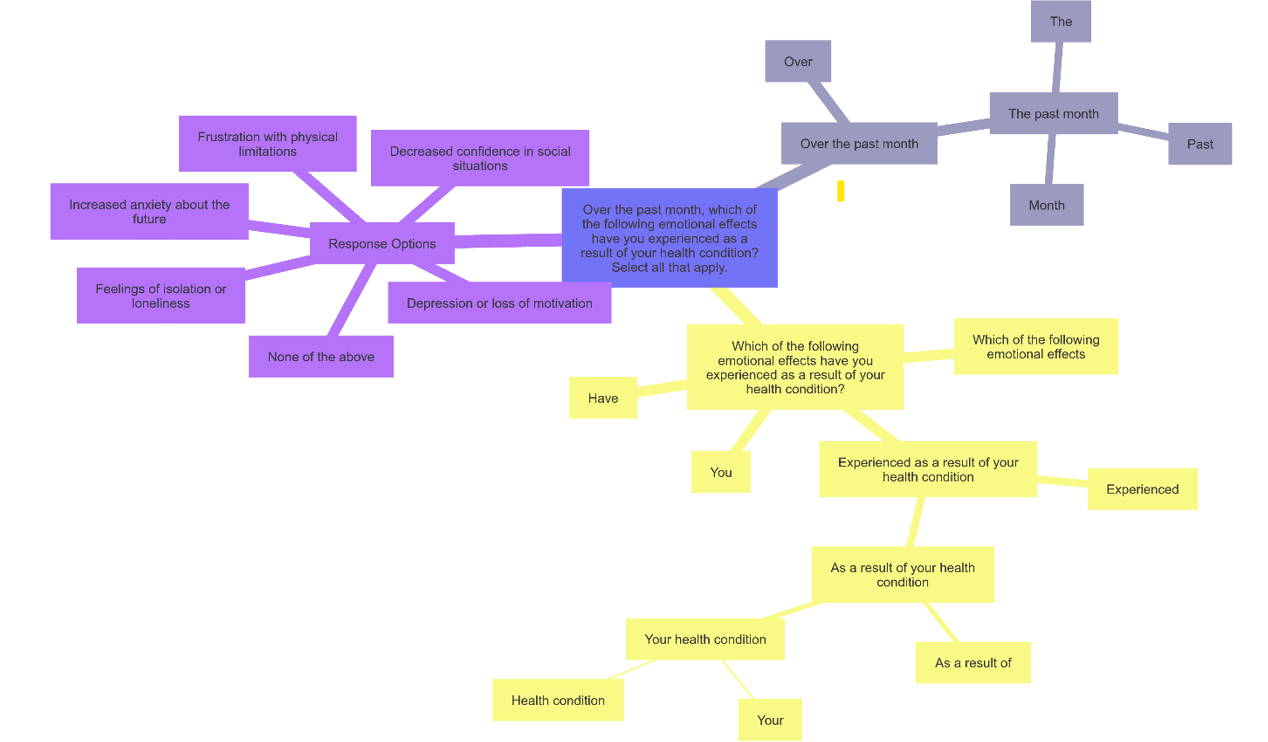
CBS Visual Map (Mermaid Mindmap)
What This Shows
Branching complexity: Unlike binary or frequency items, this checklist splits into multiple possible endorsement paths. Patients must evaluate each option independently.
Working memory demand: Patients must scan all six options, hold potential matches in mind and decide which to tick. This adds load compared to single-response formats.
Attribution: Each option must be judged not just as an emotion but as an emotion cause by health condition. That attribution step makes the task harder.
Overlap: some descriptors, e.g. depression or loss of motivation versus feelings of isolation or loneliness blur boundaries, increasing decision complexity.
CBS Chunk Comparison
Item Type | Example | CBS Core Steps | Chunk Count (approx.) | Why It’s Harder / Easier |
Binary (Yes/No) | “In the past week, did you experience pain?” | 1. Timeframe | ~4 chunks | Already at Cowan’s 4±1 limit. Simple scale, but recall + attribution still demanding under stress. |
Frequency (Ordinal Scale) | “Over the past month, how often have you felt anxious or worried about your health? (Never → Always)” | 1. Timeframe | ~5–6 chunks | Requires estimation, compression of multiple episodes, and interpreting vague terms (rarely, sometimes, often). Goes beyond 4-chunk comfort zone. |
Checklist (Multi-select) | “Over the past month, which emotional effects have you experienced as a result of your health condition? Select all that apply.” | 1. Timeframe | ~6–7 chunks (scales with # of options) | Recognition-based (easier than free recall), but scanning, overlap between terms, and attribution make it cognitively heavy. WM load rises as list length grows. |
Key Insights
Binary items: deceptively simple; already press against working memory limits.
Frequency item: add aggregation and fuzzy mapping, raining demand to around 5 to 6 chunks.
Checklist items: shift to recognition, which is easier than recall but scanning and multi-selection push the load to around 6 to 7 chunks (and even higher with longer lists).
In other words, the complexity of item type determines how working memory is loaded. Binary = recall + mapping. Frequency = recall + aggregation + interpretation. Checklist = recognition + scanning + attribution.
In the next article, we turn to a more complex kind of frequency item, one that addresses involuntary and distressing experiences. Unlike the earlier examples that focused on straightforward constructs like pain or worry, this type of item layers multiple clauses, examples and attribution into a single long stem. It asks patients to map their experience onto a familiar five-point frequency scale, but cognitively and emotionally the task is very different. The complexity of the wording, the sensitivity of the topic and the demand to attribute experiences to traumatic events all add layers of burden that go far beyond a simple Yes/No or frequency judgement.
Thank you for reading,
Mark Gibson, Leeds, United Kingdom
Nur Ferrante Morales, Ávila, Spain
September 2025
Originally written in
English