Beyond the Magic: Baddeley’s Working Memory and Multi-Component Strain
19 dic 2025
UK
,
Spain
In the first article in this series, we revisited George A. Miller’s famous Magical Number Seven, Plus or Minus Two (1956). We saw that the number seven was never a fixed law of human memory but a piece of rhetoric. Later research, particularly Nelson Cowan’s four ± one framework, revealed a much stricter limit. For patients completing Clinical Outcome Assessments (COAs), this matters: what seems simple on paper often demands more working memory than they have available in practice.
But Miller’s framing assumed a single “box” for short-term memory. The decades that followed transformed this view. Alan Baddeley and Graham Hitch (1974) introduced a multi-component model of working memory that shattered the idea of a single store and replaced it with a more nuanced picture. They argued that working memory consists of multiple subsystems, each with its own bottlenecks, overseen by a central executive. Later, in 2000, Baddeley added a fourth component: the episodic buffer.
This shift matters for understanding COAs. It reveals that patient burden does not fall on just one channel of memory but several subsystems simultaneously: verbal, visual, executive and integrative. A well-designed question can minimise strain; a poorly designed one can overload multiple subsystems at once.
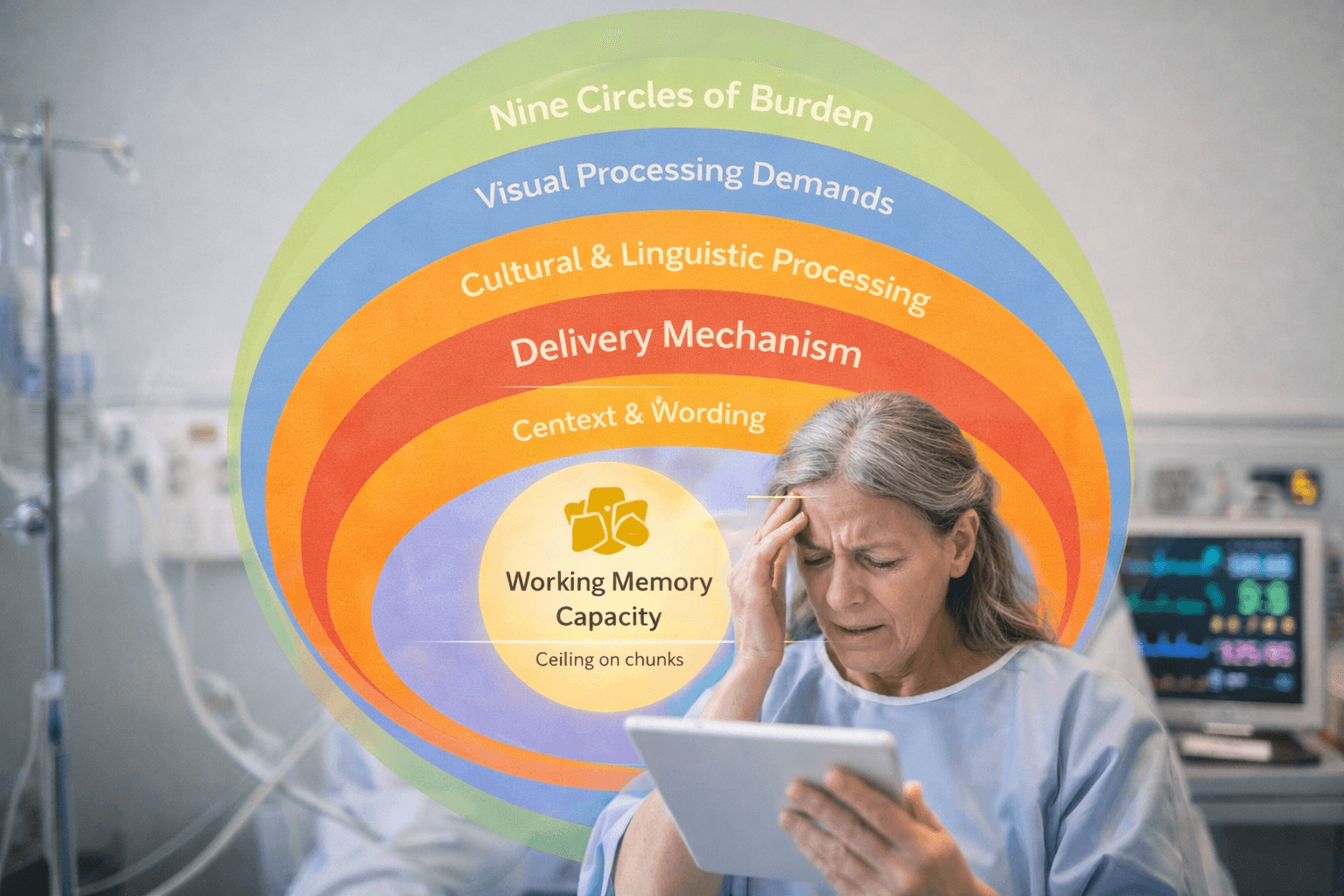
In this article, we explore Baddeley’s model and show how it illuminates Circles 2, 3 and 4 of the Nine Circles of Burden, while also foreshadowing the outer layers of strain.
From Single Store to Multi-Component
Miller and his contemporaries thought in terms of a single short-term store. You could keep about seven digits, letters or words and then either rehearse them into a long-term memory or lost them.
But experimental puzzles soon emerged. In dual-task experiments, people could perform a visual task and a verbal task simultaneously almost as well as separately but performance collapsed if both tasks were verbal or both were visual. This suggested separate subsystems for handling different kinds of material.
Baddeley and Hitch (1974) proposed three components:
1. Central executive: a supervisory system directing attention, switching between tasks, suppressing distractions and coordinating the other subsystems.
2. Phonological loop: an “inner ear” and “inner voice” for holding and rehearsing verbal material.
3. Visuo-spatial sketchpad: a workspace for visual and spatial information.
In 2000, Baddeley added a fourth:
4. Episodic buffer: a limited capacity system integrating information from the loop, sketchpad and long-term memory into unified episodes.
This model better captured the complexity of real cognition. It can also explain better why COAs can be so burdensome.
The Phonological Loop: The Burden of Words
The phonological loop holds speech sounds for about two seconds. It consists of:
A phonological store (“the inner ear”) that keeps auditory traces.
An articulatory rehearsal process (“the inner voice”) that refreshes them before they decay.
Evidence comes from:
Phonological similarity effect: lists of similar-sounding words (cat, hat, bat) are harder to recall.
Word length effect: short words are recalled more easily than long ones.
Articulatory suppression: repeating an irrelevant word (“the, the, the”) disrupts rehearsal.
Relevance to COAs:
Long stems with polysyllabic or jargon-heavy wording, such as “During the past four weeks, considering your physical, emotional and social functioning…” exceed the two-second window. Patients lose track before they reach the end.
Translations into languages with longer words (Welsh, German) further reduce span (although can we assume that the span is the same for speaks of other languages? If we make that assumption, we fall into the same trap of Anglo-centric bias that plagues COA development).
Dense response scales, like never, rarely, occasionally, sometimes, often and always, overload phonological rehearsal, especially if items sound similar when translated.
This maps directly to Circle 3: Cultural and Linguistic Processing, since the phonological loop is language-dependent and fragile in translation.
The Visuo-Spatial Sketchpad: Grids and Alignment
The visuo-spatial sketchpad holds and manipulates visual and spatial information. It allows us to:
Maintain mental images.
Track spatial layouts.
Manipulate shapes and orientations.
Evidence comes from tasks like remembering object locations or mentally rotating shapes. Importantly, the sketchpad is relatively independent of the phonological loop: people can remember a sentence while tracking a moving dot, but not two sentences at once.
Relevance to COAs:
Shared-stem items with grid layouts place heavy demand on the sketchpad. Patients must visually align the stem with each row and response options.
eCOAs on small screens increase visual burden: scrolling hides stems, forcing patients to track alignment mentally.
Poorly designed tables or overlapping boxes create confusion, increasing errors not from misunderstanding but from visual working memory overload.
This connects directly to Circle 2: Visual Processing Demands. The sketchpad is taxed by clutter, alignment and layout. It also interacts with Circle 3, where different scripts affect scanning patterns.
The Central Executive: Switching and Suppression
The central executive is less a storage system than a control hub. It:
Allocates attention.
Suppresses irrelevant distractions.
Switches between tasks.
Integrates memory with goals.
Its limitations show in dual-task interference: two tasks tapping the same subsystem interfere; cross-modal tasks do not.
Relevance to COAs:
Patients must switch between parsing, recalling and decision-making. A long stem may require them to suppress irrelevant detail, recall relevant experiences and then map them to options, all while under time pressure.
Anxiety, pain or fatigue (Circle 5: Contextual Stressors) reduce executive control, making it harder to sustain focus.
Multi-part items (“Rate your quality of life… considering physical and emotional wellbeing…what factors contribute most?”) stretch the executive by requiring integration, switching and prioritisation at once.
This links closely to Circle 4: Delivery Mechanisms. On paper, the executive can scan the whole page; on eCOA, it must juggle disappearing stems and hidden options, increasing switching costs.
The Episodic Buffer: Integration and Attribution
Added in 2000, the episodic buffer integrates material across subsystems and with long-term memory. It creates unified episodes. For example, it combines sights, sounds and context into a memory of a conversation.
Relevance to COAs:
Global evaluative items (“How would you rate your quality of life, considering physical and emotional domains?”) require buffer integration: physical symptoms + emotional state = one rating.
Attributional items (“What factors contribute most?”) demand integration of multiple long-term schemas with current judgement.
This episodic buffer is easily overloaded. Patients may default to whichever domain is most salient, neglecting orthers.
This function anticipates Circle 5: Contextual Stressors and Circle 6: Adaptation and Wording Quality, since stress reduces integrative capacity and poor wording multiplies what must be integrated.
Multi-Component Strain in COAs
Baddeley’s model shows that memory is not one pipeline but multiple subsystems. The tragedy for COA design is that many items overload several subsystems at once:
Phonological loop: long stems, jargon-heavy text, translations that do not resonate, dense scales.
Visuo-spatial sketchpad: grid layouts, scrolling screens, misaligned rows.
Central executive: switching between parsing, recall, decision-making; suppressing irrelevant detail.
Episodic buffer: integrating multiple domains into one rating, attributing causes.
A simple binary item may stress only the phonological loop and executive, while complex global items stress all four at the same time.
What We Learn
From Baddeley’s model we learn that working memory is not a single bottleneck but a cluster of fragile subsystems. Each has its own limits and COAs often demand more than one at the same time.
Patients are not blank processors. They are juggling auditory rehearsal, visual tracking, attention control and integration of multiple domains.
Design matters. A COA that is linguistically simple but visually cluttered may overload the sketchpad. One that is visually clean but linguistically dense may overload the phonological loop. One that requires integration may collapse the episodic buffer.
Context amplifies stains. Pain, fatigue and stress (Circle 5) reduce executive and integrative capacity, making suppression and synthesis harder.
The CBS shows the sterile core: parsing, recall, mapping. Miller showed us the apparent limit of chunks. Cowan revised it down. Baddeley shows us why: because multiple fragile subsystems are being stretched in parallel.
Conclusion
In the Nine Circles of Burden model, the first circle is working memory capacity. This is the strict ceiling on chunks. Baddeley’s subsystem illuminate the next layers:
Circle 2: Visual processing demands leads to visuo-spatial sketchpad overload.
Circle 3: Cultural and linguistic processing leads to phonological loop fragility.
Circle 4: Delivery mechanism leads to central executive strain.
Circles 5 and 6: Context and wording leads to episodic buffer overload.
The lesson is that designing COAs is not simply about not using jargon or keeping scales short. It is about recognising that each subsystem of working memory is a point of vulnerability. When multiple subsystems are stressed together, even simple items can become unmanageable.
In the next article, we move outward again, from the sterile core and then the architecture of working memory to the lived burdens of stress, anxiety, pain, poor adaptation and formatting conventions. Together, these fill the remaining circles of burden, transforming what looks like a neat question into a very messy ordeal.
Thank you for reading,
Mark Gibson, Ávila, Spain
Nur Ferrante Morales, Ávila, Spain
September 2025
Originally written in
English