I Ain’t Gonna Work on Maggie’s Farm No More… Or So I Thought
Dec 4, 2025
Mark Gibson
,
United Kingdom
Health Communication and Research Specialist
What I learned after decades of walking away, burning bridges and calling it freedom.
The latter part of 2024 and the early part of 2025 have felt like life inside a chrysalis. I entered as one shape: defiant, principled and hardened. And slowly, I have been breaking out as something else. Not softer, exactly, but different. A bit more reflective and less certain. Entering the chrysalis was not something that I planned or did deliberately: life simply forced a change. The chrysalis started enveloping me and there was nothing I could do about it.
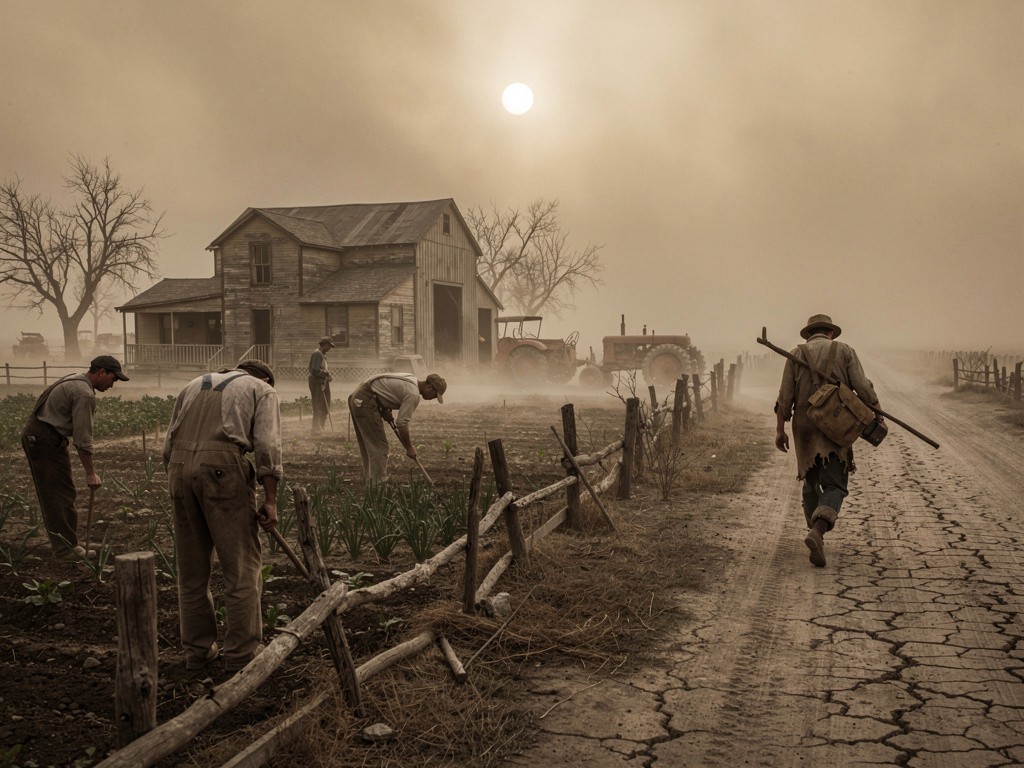
For decades, I measured dignity by how easily I could say “no”, how quickly I could walk away. Jobs, projects, clients, business partnerships – if I sense exploitation, hypocrisy or hollowness, I could not stay quiet, fume politely or play the long game like most civilised people. I had to pull the plug, take my ball home, throw out the bathwater. I was not going to work on Maggie’s Farm no more.
It sounds wild to admit now, but I literally lived by the Bob Dylan’s song Maggie’s Farm. His sly, surreal sneer in the original version and then, years later, the Rage Against the Machine cover: loud, unrelenting and incendiary. This is an anthem for anyone who refuses to pretend that everything is fine, who refuses to be a cog in a machine, who is not here to be used. It was more than a song. It became a worldview.
The chrysalis taught me, however, that I had never been really free. I had always been a cog. I was small, like everyone else. Everybody is just trying to make something work where there are no alarms and no surprises. And I was not as right, or as righteous, as I thought.
If You Are the Big Tree…
Maggie’s Farm was Dylan’s protest against exploitation, yes, but also a reclamation of identity. It echoed Steinbeck’s of Mice and Men in its heartbreak: labour, disillusionment and dreams of empowerment that are simply too big to fight about.
“I will try my best / To be just like I am / But everybody wants you / To be just like them.”
It was my war cry. And alongside that, I carried another lyric, this one from Bob Marley in the song Small Axe:
“If you are the big tree, we are the small axe.”
This made me feel brave and noble. A lone consultant, wielding my ethics like an axe, chopping away at corporate dysfunction, one swing at a time.
Dignity by Way of Exit
So I took those two stances – Maggie’s Farm and Small Axe – into the commercial world.
And this is what I failed to see at the time:
Consulting gave me a professional framework to act out my personal rebellion. Every client engagement became a moral proving ground. Every business decision became a test of integrity. If something smelled wrong, I didn’t stay and try to shift it. I walked away. Always with a bang. Always with a burning bridge in my wake. Off to another farm. Sharpen the axe for another tree.
Breaking off a business arrangement definitely felt like power.
If there was a hint of a shift from best practice, or thought there was unreasonable behaviour or felt the partner was disrespecting me? I left.
But over time, something became impossible to ignore:
Every new relationship eventually started to resemble Maggie’s Farm. This was because I had trained myself to expect it. I did not see nuance, nor did I allow for discussion or evolution. I was only too ready to chop down this new big tree.
And eventually, there was a body count. So many farms I had left behind. So many fields scorched. Notices given. Feelings expressed. Gates slammed shut. All by me.
The conferences started to feel like a haze of awkward nods, sidelong glances, avoidances. Elephants in the room. You could almost smell the burn of those bridges and the lingering ash. This is the memory of the exits, the final calls, the partnerships brought to an abrupt end.
No Longer Alone
So far, I mentioned ‘I’, ‘me’ and ‘my’. It is true, I made the majority of these exits within my own sole consultancy. But, as I built a team, I did not consider that it was not my decision anymore. And this is where the real weight hit, during the recent chrysalis phase.
A small, loyal group of incredibly talented people were following me out of contracts, out of partnerships and security. I was taking my team from situation to situation like a band of resilient survivors, The Walking Dead style, moving from one broken camp to another. I thought we were guided by principle, toughness and loyalty. But the people in my team are not warriors. They are raising children, paying for their educations, caring for parents, paying mortgages and car loans. And I kept taking them with me, believing the next partnership would be better. There would be a utopia of generous timelines, nice budgets, partners who want to build a friendly relationship and not just a transaction.
That place never came. And the problem was not the clients. It was how I was viewing them. I wanted to break away from Maggie’s Farm, but the fact is that everywhere is Maggie’s Farm, if that is what you want it to be. How was I so naïve to expect any different?
Whosoever Diggeth a Pit…
That Bob Marley song, Small Axe, has an important lyric, taken directly from the Old Testament (Proverbs 26:27 and Ecclesiastes 10:8):
“These are the words of my Master: whosoever diggeth a pit shall fall in it.”
And that is what happened. I thought I was cutting down injustice with every departure. But I was also digging my own pit. Worse than that: it was ego-driven, fuelled by my own rigidity and by the stories I told myself about what it means to be ‘principled’.
This was just ego wrapped in a sense of righteousness. I could have buried the entire team in that pit alongside me.
The hardest thing to admit is this:
I confused leadership with defiance and I let my own discomfort outweigh other people’s stability. This is the very opposite of leadership. A team does not need a drifter. They need a builder. A listener. Someone who knows how to hold fire without burning down the bridge.
And what stings the most is this:
Bob Dylan was barely in his twenties when he wrote Maggie’s Farm. This was a young man, angry at a system he barely understood. And Rage Against the Machine is pure adolescence: paper-thin noise and nothing more. A loud teenage strop.
Why was I carrying this, not even as a worldview, but as a fundamental attitude?
The soundtrack of corporate-sponsored resistance is not the same as the substance of wisdom.
And another sting is about the people I had those rough professional breakups with: the clients, the partners, the collaborators that I left in the smoke. I gave no thought to how you dealt with it. No space for the possibility that you were evolving too, that you had your own pressures and your own imperfect hierarchies to navigate.
For that, I am sincerely sorry.
This is what the chrysalis I described earlier did for me. It held me still. It made me reflect. I emerge different and very grateful. I contemplate and navigate very big skies now while in full understanding of the smallness and vulnerability of an individual. An individual, just like me. Not as a realisation of weakness, as something to fix, or something to rage against, but as a perspective and an objective truth.
Thank you for reading,
Mark Gibson
Leeds, United Kingdom, June 2025
Originally written in
English