Cognitive Load and Shared-Stem Questions in Non-Western Script Contexts
Dec 18, 2025
Mark Gibson
,
UK
Shared-stem questions are a common efficiency technique in Western survey design, where a single introductory stem is provided, followed by a series of related sub-items. Here is a shared-stem question that we have paraphrased from a real one:
Stem: “In the past week, how often have you experienced the following symptoms?
a) Fatigue
b) Nausea
c) Anxiety
d) Insomnia”
This format is cognitively efficient for left-to-right, alphabet system users but can create substantial cognitive friction for readers accustomed to non-left-to-right scripts, such as Arabic, Hebrew or non-alphabetic systems, such as Chinese, Japanese and Korean.
Key Cognitive Load Issues in Shared-Stem Questions
1. Memory Load Amplification
For native speakers of languages like Arabic, a right-to-left script, or Chinese (logograph system), holding the stem sentence in working memory while reading and interpreting subsequent sub-items demands additional mental effort.
In Western reading logic, the stem sits above and to the left of the items and the eye is trained to “pull” context from the top-left.
In right-to-left script readers, like Arabic users, visual scanning habits naturally move rightward first. This means that jumping back to a top-aligned stem is intuitive, requiring conscious reorientation.
It is unbelievable that some right-to-left eCOA translations and configurations are still placed to the top-left, rather than the top-right. When this happens the cognitive burden and conscious reorientation for right-to-left is compounded even more.
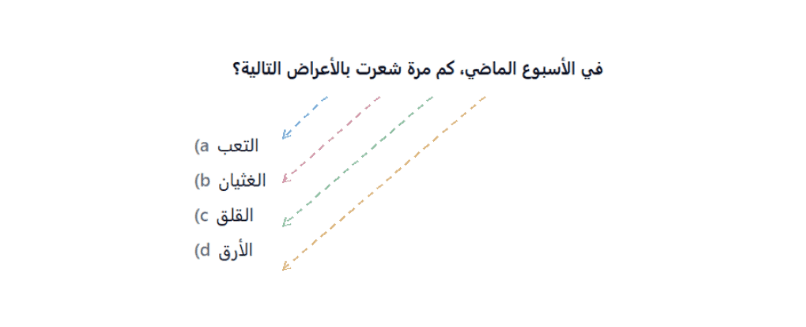
This is what we mean:
Exhibit 1

What is wrong with the first mock-up?
The stem is in Arabic (RTL) but the answer options (side effects) are visually aligned as if in LTR, hugging the left side of the box.
Burden created:
o Visual dissonance: An Arabic reader’s natural eye entry point is top-right, but the items appear on the left margin.
o Re-orientation cost: Each item requires a zig-zag scanning motion, starting right (habit), jump left (actual placement).
o Working memory load: the reader must keep the stem in working memory while making extra visual leaps across the screen.
Below is a mock-up of a heat map / eye tracking mapped onto this item presentation:

So, the RTL reader is naturally going back to a right position where they expect to see the side effects presented there in languages like Arabic, but there is nothing there.
The result is that this increases extraneous cognitive load, effort not related to the task (symptom recall), but to the navigation of a misaligned layout.
Here is another version of this, where response choices are also positioned in a LTR position:

Eye-tracking / heat map mock-up:

This means that the eye keeps naturally going back to the right-hand side, but there is nothing there, which means that the eyes have to quickly reconfigure.
The result is that this amplifies intrinsic load, i.e. the core comprehension effort of the question, by adding unnecessary spatial re-mapping demands.
The overall cognitive burden across both layouts:
Working memory overload involves constantly needing to “hold the stem in mind”.
Visual search effort involves unnatural eye-movements, scanning across the wrong axis.
Increased error risk means that items could be skipped or the item-stem link could be misinterpreted.
This increases respondent fatigue, which means higher drop-off, slower completion and reduced data quality.
Exhibit 2
(Disclaimer: AI couldn’t handle the generation in Arabic script and could only do schematic placeholders)

Here is a mock-up of the eye-tracking / heat map of this configuration:

🌕 Large yellow fixation top-right (where RTL readers first look).
🔴 Red fixation on the stem (misplaced left).
🟠 Orange fixations on each symptom (right margin).
➖ Clear zig-zag pattern: every symptom → stem → next symptom, showing the constant reorientation burden.
What’s wrong: The stem is positioned at the top-left (like in English), while the answer options are RTL.
Burden created:
o Anchor conflict: the reader’s attention naturally begins at the top right, but the stem is “out of place”. They have to search for it at the left.
o Context loss: As they move through the items (on the right), recalling the stem requires jumping across the layout back to the left, disrupting fluency.
o Memory strain: Instead of “anchoring” context spatially (at the start of their natural reading path), the respondent has to hold it in working memory for longer.
Key Cognitive Load Issues in Shared-Stem Questions
1. Memory Load Amplification
For native speakers of languages like Arabic (RTL) or Chinese (logographic system), holding the stem sentence in working memory while reading and interpreting subsequent sub-items demands additional mental effort.
In Western reading logic, the stem sits above and to the left of the items and the eye is trained to “pull” context from the top-left.
In right-to-left (RTL) readers, like Arabic users, visual scanning habits naturally move rightward first. This means that jumping back to a left-placed or top-aligned stem is unintuitive, requiring conscious reorientation.
In short, the directionality mismatch between how the COA is formatted and how the reader’s brain is trained to process text adds extraneous load.
2. Disruption of Reading Flow
In logographic or mixed-script systems like Chinese or Japanese (kanji plus kana), reading units are visually dense and meaning is often derived contextually. Shared-stem formats interrupt this natural reading pattern:
The stem is semantically distinct from each sub-item, forcing the reader to “retrieve” the same content multiple times.
Without the redundancy of repeating the stem in each item, readers from these systems may decouple the sub-item from its original context, leading to misunderstandings.
For instance, item “d) insomnia” might be read independently as a general health question, rather than specifically framed by the “past week” timeframe.
3. Increased Cognitive Re-orientation
Readers from RTL systems, such as Arabic and Urdu, will not only face a directional switch in text layout but also a visual layout mismatch:
In Western COAs, shared-stem questions are typically laid out vertically, with stem on top and items stacked below. This is dissonant for readers who expect a horizontal RTL text flow, leading to additional cognitive “gymnastics”.
If the translation leaves the layout LTR but switches the text to RTL, the patient may now face bimodal processing, where the page looks LTR but the text reads RTL. A surprising number of translated COAs are precisely like this.
4. Increased Re-Reading Behaviour
Studies in cross-linguistic survey design have shown that participants from non-Western script systems often resort to re-reading the stem before answering each sub-item, especially when unsure if the stem is still “active” or has shifted.
Each instance of returning to the stem taxes working memory and slows down the process.
This is especially problematic in paper-based COAs, where no automated reminder of the stem exists next to each sub-item.
5. Cultural Expectations for Question Structure
In many non-Western survey styles:
Questions are often designed to be self-contained (stem plus item in one unit) to minimise ambiguity.
Sequential logic (Q1, Q2, Q3) is favoured, rather than “one stem + many stacked items” structures.
Thus, shared-stem design feels foreign and may create confusion about whether sub-items should be read independently or as part of a chain. This mismatch between cultural questionnaire norms and Western design conventions further increases intrinsic and extraneous load.
6. Translation Challenges
When shared-stem questions are translated:
The semantic cohesion between the stem and items may weaken if stems are not perfectly adaptable to the target language’s grammar or reading habits.
For example, Japanese or Korean translations might require subject/object clarification in each sub-item that is assumed to be “carried over” from the stem in English.
In effect, shared-stem structures can disrupt meaning clarity in non-LTR and non-alphabetic systems.
Summary of Cognitive Load Factors with Shared Stems
Cognitive Load Type | How Shared-Stem Questions Contribute |
Intrinsic Load | Unfamiliar question framing adds natural complexity. |
Extraneous Load | Directionality mismatch, stem-item separation, re-reading. |
Memory Load | Holding stem in working memory while reading distant items. |
Cultural Load | Non-Western norms favour self-contained items, not shared stems. |
Emotional Load | Frustration/confusion from non-intuitive layout and navigation. |
Design Recommendations
To reduce this type of load in multilingual, multicultural COAs, consider:
1. Repetition of the stem: Restate the core stem in every sub-item, especially in RTL or logographic-script versions.
2. Localised layout adjustments: Flip the layout or visually reformat RTL version, such as aligning items rightward and repositioning stems to fit natural reading patterns.
3. Do not use a shared-stem structure altogether for populations where it introduces significant cognitive load. Instead, opt for full, self-contained questions.
4. User Testing: Specifically look for “slow zones” where participants linger or re-read stems, which often correlate with shared-stem sections.
The next article focuses on the cognitive load and non-Western script readers in clinical questionnaire in other areas of COA design, moving beyond shared-stem design.
Thank you for reading,
Mark Gibson, Leeds, United Kingdom
August 2025
Originally written in
English