
The Cognitive Burden Simulator: The case of a COA Item with a Binary Response Choice
23 dic 2025
UK
,
Spain
In this article we take the Cognitive Burden Simulator (CBS) and apply it to a simple COA item:
"In the past week, did you experience any pain?" (Yes/No)
What is Easy About This Item?
1. It has simple syntax
It is a short sentence, basic word order (Subject-Object-Verb)
There are no embedded clauses or long noun phrases.
2. Familiar vocabulary
It contains everyday terms, such as “week” and “pain”, although “experience” a little higher register (“feel” or “have”, maybe, for clearer communication?)
There is no medical jargon.
3. Clear time frame
"In the past week” sets a recent, bounded recall window.
Patients do not need to consider their whole medical history.
4. Binary response format (Yes/No)
This creates minimal decision-making burden.
There is no need to weigh frequency or intensity.
What is Difficult About This Item?
1. Memory recall
The patient must scan back over seven days.
Episodic recall is cognitively demanding, especially for people with fatigue, pain or cognitive impairment.
2. Ambiguity in the definition of “pain”
Pain is subjective and multidimensional: sharp, dull, burning, fleeting, persistent.
Does a headache count? What about stiffness? Is discomfort the same as pain?
3. Binary oversimplification
The Yes/no choice forces reduction of a complex experience.
A patient with minor, infrequent pain may hesitate: Is that worth a “Yes”?
4. The timeframe can only ever be an estimation
Difficulty distinguishing whether a pain episode occurred within the exact window, i.e. “was that headache I had 6 or 8 days ago?”
Boundary effects: events just outside the window may still influence the answer.
5. Emotional/cognitive interference
Pain can carry emotional weight plus anxiety, frustration and avoidance.
This may bias recall or encourage under-reporting.
6. Cultural and/or linguistic variation
In some languages or cultures, “pain” as a concept may overlap with “soreness”, “ache” and “discomfort”.
Translation issues can shift the cognitive burden: is the term in the target translation broader or narrower? In the translation process, has it gain nuances through cultural coating or lost something through cultural stripping?
CBS Breakdown Table
Level | Component Type | Text | Notes |
Root | Sentence | In the past week, did you experience any pain? | Whole sentence |
1 | Prepositional Phrase | In the past week | Timeframe |
2 | Preposition | In | Introduces timeframe |
2 | Noun Phrase 1 | The past week | Object of preposition |
3 | Determiner 1 | The | Defines the noun |
3 | Adjective | Past | Qualifies the noun |
3 | Noun 1 | Week | Head of NP |
1 | Main Clause | Did you experience any pain? | Core question |
2 | Auxiliary Verb | Did | Question marker |
2 | Subject | You | Person answering |
2 | Verb Phrase | Experience any pain | Predicate |
3 | Verb | Experience | Main action |
3 | Noun Phrase 2 | Any pain | Object of verb |
4 | Determiner 2 | Any | Quantifier |
4 | Noun 2 | Pain | Head noun |
1 | Response Options | Yes / No | Binary choices |
And the CBS Visual Map for this item:
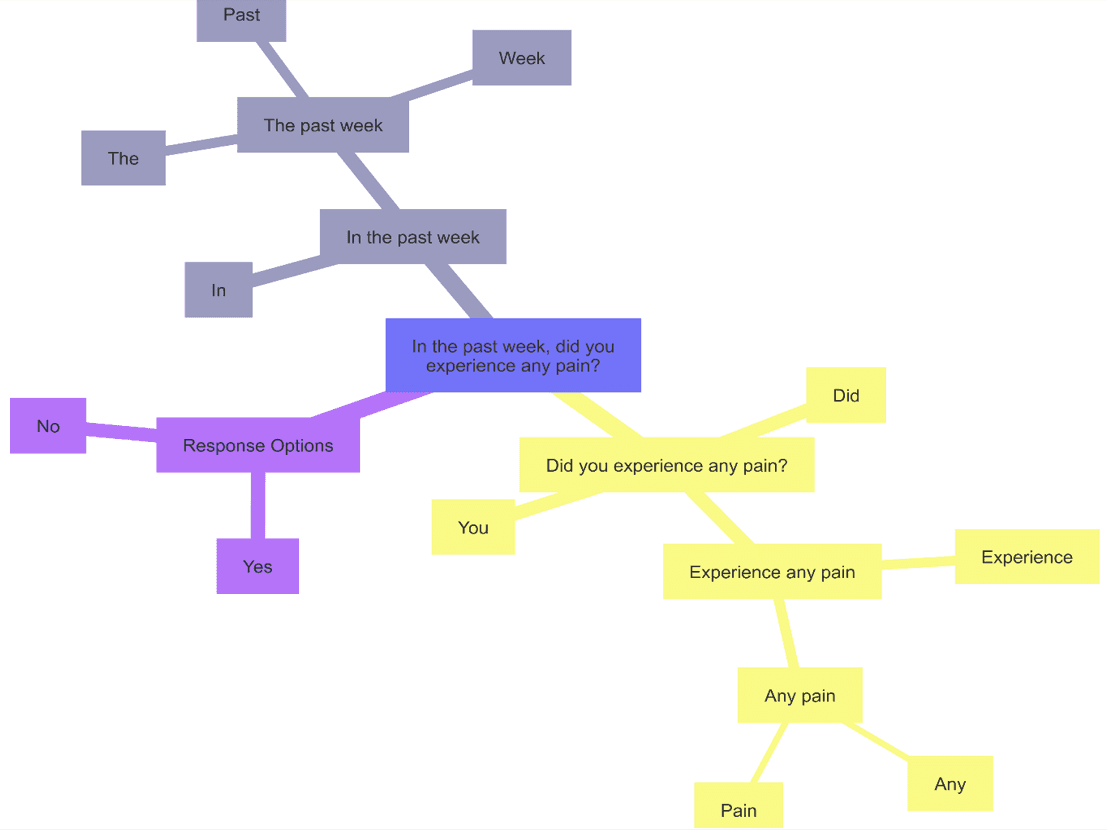
What we learn from this CBS analysis is that even a question that looks deceptively simple requires the patient to juggle multiple concepts simultaneously. To answer, they must hold in mind the timeframe (“in the past week”) and the concept of pain, which itself may be ambiguous: does a mild headache count? What about stiffness? Then, the act of recall across recent days and the mapping of that recollection to a binary Yes/No response.
In effect, a patient is carrying four or five separate chunks of information in working memory just to process and respond to this single, simple item. For a healthy respondent in ideal conditions, this may sit at the end of cognitive capacity; for a patient under stress, pain, fatigue or with limited health literacy, it may already exceed it. What looks like a straightforward Yes/No question is, in practice, a small exercise in mental gymnastics.
The next articles will look at other Clinical Outcome Assessment items that gradually increase in their complexity and, of course, the cognitive burden imposed on patients.
Thank you for reading,
Mark Gibson, Harrogate, United Kingdom
Nur Ferrante Morales, Ávila, Spain
September 2025
Originally written in
English