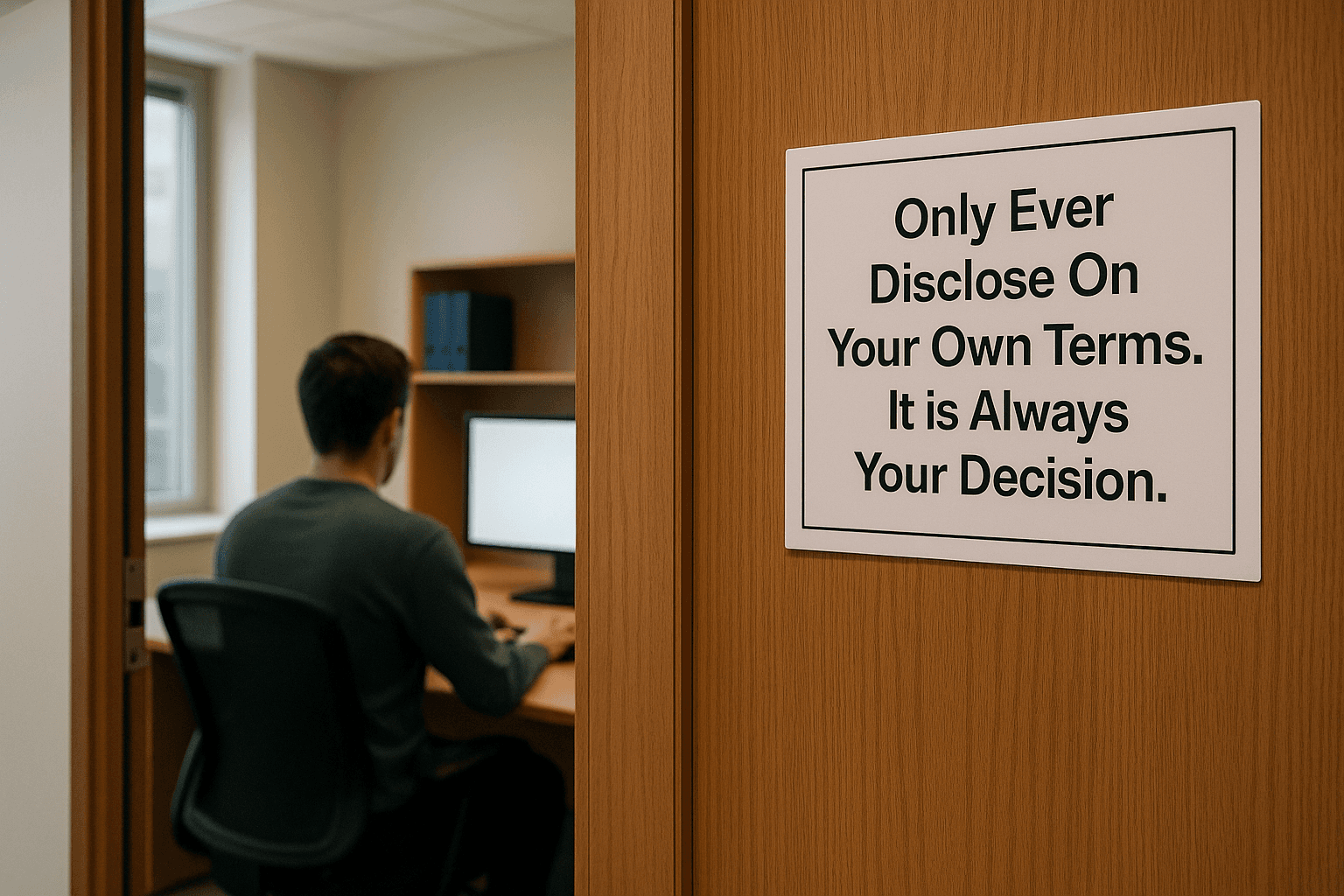
The Variable of Disclosure: Navigating Neurodivergence in the Workplace
Dec 8, 2025
Mark Gibson
,
United Kingdom
Health Communication and Research Specialist
Overlaying every workplace challenge faced by professionals with neurodivergence is one relentless and high-stakes question:
Do I tell them?
The decision to disclose at work is deeply personal and complex. Most of the time, you do not know how it will turn out: would it offer relief or invite risk? Would it open doors or quietly close them? Also, it is not just a question of whether to disclose, but when, how and to whom.
Because the outcomes are unpredictable, the stakes feel constant. And no matter what path you take, the emotional toll is immense, regardless of the outcome.
There are three realities that shapes a person with neurodivergence’s experience of work:
· Whether they have disclosed.
· Whether they have chosen not to disclose.
· Whether they do not even know they are neurodivergent.
These three realities, each of which I have lived, are distinct but most overlap with each other. They shape the emotional terrain of the workplace in ways that are invisible to most, but all-consuming for those living them.
This article looks at each reality with a personal account of how each one was for me.
1. Disclosed Neurodivergence
“This is who I am. And I am claiming and naming it.”
For people who choose to disclose their neurodivergence, there can be a sense of liberation. When you name the experience by bringing it into the open, it creates a space for self-respect, potential support and even advocacy. It can unlock access to reasonable adjustments. For this, you usually have to be armed with an official diagnosis, your ‘autism certificate’ – the outcome of weeks of formal clinical assessment with actual clinical psychologists, and not something you order through TikTok or Instagram and receive within 48 hours.
A formal disclosure can open conversations in your workplace around inclusion and, if you so wanted, you could be the leader on neurodiversity within the wider company.
However, disclosure is not without its costs. Stigma is still real, even when it hides behind civility.
The sociologist Erving Goffman, in his work Stigma: Notes on the Management of Spoiled Identity (1963), wrote that stigma is not only about difference, but it is also about disqualification. You are not devalued simply for being different, but for having a difference that others define as “undesirable”. Goffman called this the transformation from a “whole and usual person” to someone whose identity becomes “spoiled”. Just consider how ingrained this is in our discourse and how we talk about differences in ability:
· English: dis-ability (literally, ‘not able’)
· Spanish: minus-válido (literally, ‘less valid’)
· German: Behinderung (impediment, hindrance, obstacle), and so on.
When someone discloses their neurodivergence, their identity can be quietly reinterpreted, not necessarily out of cruelty, but through neurotypical frameworks and potentially inaccurate mental models of how the neurotypical framework views neurodivergence. It is all about others not knowing what to do with this new information, this new difference. From being regarded as a ‘detail-oriented’ person, you are now seen as ‘rigid’. From ‘direct’, you are now ‘blunt’. Disclosing puts past behaviour into a new frame, and it risks distorting how future behaviour is seen.
Goffman also emphasised the burden of ‘information control’. This is the work that goes into managing what others know about your identity. For employees with neurodivergence, disclosure becomes a complicated transaction: while you are sharing a truth about yourself, you are also giving up control over how this disclosure will be interpreted. Even when disclosure leads to support, it can also lead to condescension, lowered expectation and being seen only through the lens of the diagnosis. It is being ‘seen’ but at the same time ‘watched’. We are back to the ‘Hell is other people’ observation of Sartre.
Apart from this article, addressed to the world, I have disclosed my situation on two occasions only and, in both cases, there has been a stepping away. I was not viewed in the same way and I could perceive it very well. While, with those clients, I was not hiding anymore, I was not exactly safe either. I truly believe the disclosure damaged me.
2. Undisclosed Neurodivergence.
“I know who I am, but I just cannot tell them”
For those who are diagnosed but choose not to disclose, the workplace becomes a strategic space: a place of constant calculation, where you wear camouflage and engage in silent trade-offs, mostly with yourself.
Staying undisclosed can protect yourself from others’ biases. You can define yourself on your own terms, at least outwardly. However, the cost of this is high: it involves a great deal of performance, of accommodations and of the invisible labour it takes to keep up the façade. You have to mask, which is to appear neurotypical. Goffman wrote about “passing”, the act of concealing a stigmatised identity so that a person can blend in with the dominant group. But this is a survival strategy, not freedom. It requires constant self-monitoring (here, to pervert the Sartre line, ‘hell is yourself’), rehearsed behaviours and vigilance. You become an actor in a play that the rest of the world has written and there is no exit stage moment. Basically, non-disclosure is a balancing act of quiet exhaustion. It weathers you. You eventually burn yourself out.
In my case, the masking and the acting were terrible. At various times in my life, I tried to imitate, to live out, what I considered popular and - I hate to use the word – cool. I never got it right. The result was always a mix of exaggeration and caricature, leading me to risky behaviours and then burnout.
3. Unaware They Are Neurodivergent
Walking into a movie in a packed cinema 25 minutes after it has started.
Probably the most disorienting experience is being neurodivergent but undiagnosed. You know that you are struggling with many things in life, but you don’t understand why. Work feels harder for you than other people, so you put in more hours just to stop yourself drowning.
You find yourself developing all kinds of coping mechanisms, such as overcompensating, self-correcting or burning yourself out. You know and everybody else knows that there is something wrong with you. You keep hearing these words ‘weird’ and ‘awkward’ and nobody sees the invisible strain you are putting yourself under. This is a time of isolation, confusion and overcorrection.
A good example of this is all the invisible work that goes into staying organised. For many neurodivergent professionals, and certainly myself, staying organised is not a default setting, it is a daily battle, especially within the myth of multitasking. Workplaces often demand seamless task-switching. The expectation is that the brain switches rapidly between tasks. This comes at a great cognitive cost even for neurotypical people. For neurodivergent individuals, this is punishing. The result is always a domino effect of forgotten follow-ups, dropping the ball, missing deadlines and then the erosion of trust. Then you are blamed for a system that does not fit, where there is a mismatch between how the brain functions and how the workplace flows. Sidebar note: some AI tools can take this struggle away from you entirely and immediately.
Final Thoughts
For neurodivergent professionals, every interaction is deliberate. Nothing is automatic and everything takes effort. But that does not make us less capable. In fact, it can make us more rigorous, more thoughtful and more focused. But a lot of us do not thrive or even survive in some professional contexts. Some of us also sink, unseen, dismissed as weird, difficult and simply ‘not fitting in’. The worst part is that, when we fail and when we struggle, we usually blame ourselves. We see ourselves as the problem and we punish ourselves, with an endless post-mortem: if only I had not said this or reacted that way. But, as Goffman might remind us, the problem is not so much us but the lens through which society sees us and neurodivergence in general.
I asked ChatGPT to sum up the pros and cons of each strategy, as follows:
Experience | Can request support? | Faces stigma? | Risk of burnout | Strategic clarity |
Disclosed | ✅ Yes | ✅ Often | ⚠️ Moderate | ✅ High |
Undisclosed | ❌ Not formally | ❌ Avoided | ⚠️ High | ⚠️ Partial |
Unaware | ❌ No | ✅ Frequent | 🚨 Very high | ❌ Low |
What would I continue to do? In truth? I would try to leave it undisclosed. Let them just think you are weird because, with the experience of the two times I had disclosed, I was definitely ‘seen’ differently and my business suffered for it. But, now, I suppose I am disclosing to all of you.
Thank you for reading,
Mark Gibson
Leeds, United Kingdom, June 2025
Originally written in
English