Study Design Biases in Clinical Outcome Assessments
Jan 12, 2026
Mark Gibson
,
United Kingdom
Health Communication and Research Specialist
Clinical Outcome Assessments (COAs) are increasingly central to evaluating treatments in clinical research. They capture not just laboratory values or imaging results but how interventions affect lived experience, such as pain, fatigue, mobility, quality of life. For regulators, payers, and clinicians, these outcomes matter because they connect directly to patient benefit.
But the reliability of COAs depends not only on patients or assessors. Study design itself can introduce systematic bias. Before any data are collected, choices about randomisation, blinding, measurement tools, inclusion criteria, and sampling shape what will be observed and how it will be interpreted. These biases are not random. They systematically tilt results, exaggerating efficacy or obscuring harm.
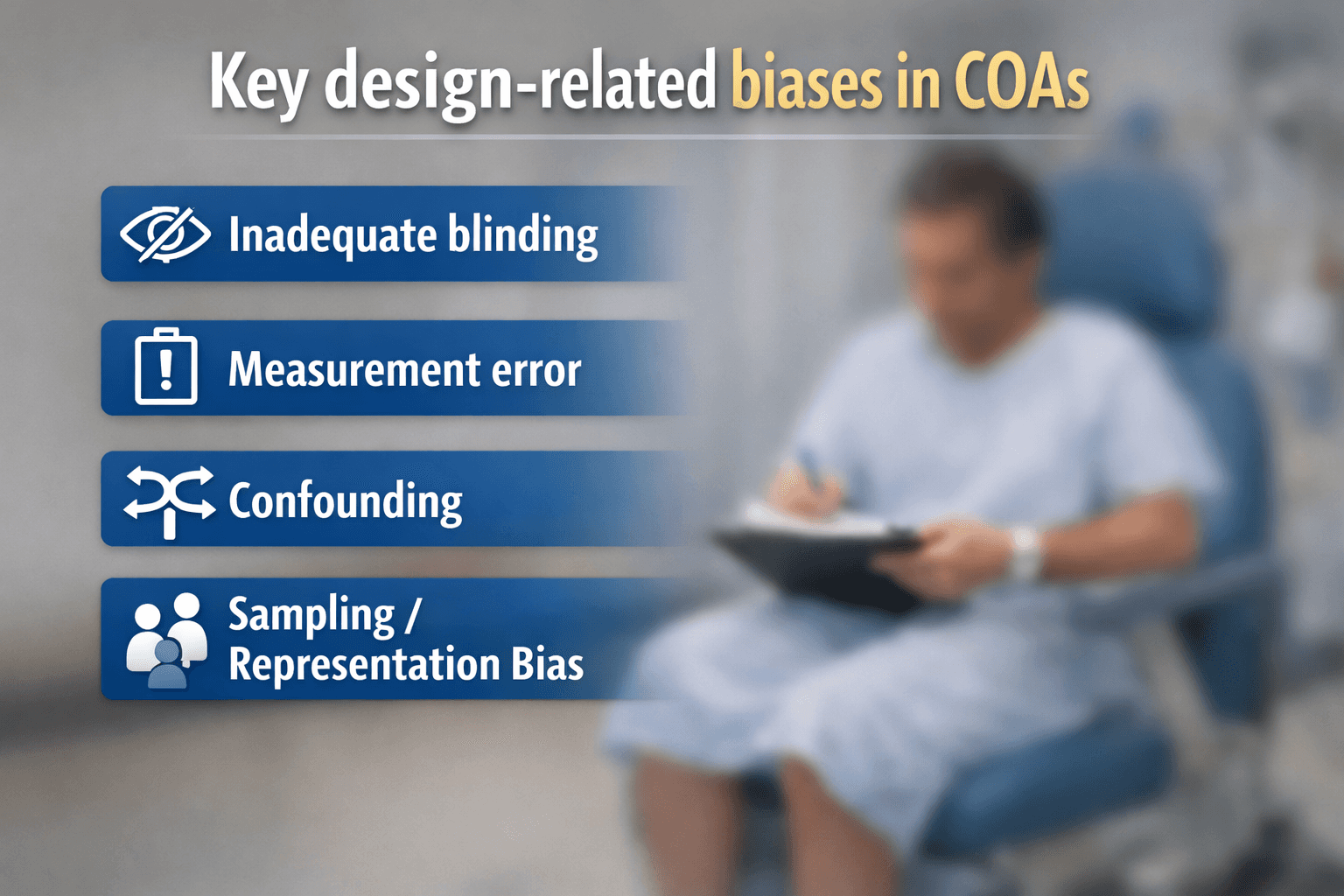
This article explores four key design-related biases in COAs: inadequate blinding, measurement error, confounding, and sampling/representation bias. It shows how they arise, their consequences, and strategies for mitigation.
Inadequate Blinding: Opening the Door to Bias
Blinding (or masking) is one of the most important defences against bias. When patients, clinicians, or assessors know treatment allocation, expectations influence both reporting and behaviour.
Patient unblinding leads to response bias: participants who know they are receiving active treatment may report more improvement (Wiley, 2024).
Assessor unblinding fuels detection bias: clinicians may unconsciously rate outcomes more favourably in the treatment arm (ScienceDirect, 2014).
Staff unblinding drives performance bias: intervention delivery may differ by group (BMJ, 2011).
Evidence: Meta-epidemiological studies show that non-blinded trials systematically overestimate treatment effects, especially for subjective outcomes (Wiley, 2024).
Impact: Without blinding, multiple biases compound, making it impossible to disentangle true effects from expectation-driven artefacts.
Mitigation:
Prioritise double-blind designs wherever feasible.
In open-label trials, use blinded outcome adjudication committees (NIH, 2019).
Rely on objective endpoints (e.g., biomarkers, accelerometry) when subjective outcomes are unavoidably unblinded.
Measurement Error: Tools That Skew Data
Measurement error occurs when instruments or methods systematically misrepresent outcomes. In COAs, this risk is acute because many endpoints rely on questionnaires, scales, or interviews.
Unvalidated tools: Using instruments without psychometric validation leads to unreliable or biased results.
Translation issues: Poorly adapted instruments in multinational trials may distort meaning (EUPATI, 2025).
Timing bias: Assessing outcomes at inconsistent times across arms creates artificial differences.
Example: A fatigue questionnaire translated inconsistently across languages may lead to systematically higher scores in one country, confounding cross-site comparisons.
Impact: Produces systematic errors that can mimic or mask treatment effects.
Mitigation:
Use validated, standardised instruments with proven reliability.
Pilot test translations and cultural adaptations.
Align assessment schedules across trial arms to ensure comparability (NHMRC, 2019).
Confounding: Hidden Variables in the Mix
Confounding occurs when differences between groups, unrelated to treatment, influence outcomes. Randomisation is designed to address this, but poor sequence generation or allocation concealment can undermine it.
Self-selection: Patients who volunteer for certain arms may differ systematically from those in others (NIH, 2021).
Physician-directed allocation: Clinicians who know patient history may unconsciously direct sicker or healthier patients toward certain treatments.
Insufficient randomisation: Small sample sizes or poor sequence generation can leave groups imbalanced.
Evidence: Reviews of randomised trials show that inadequate sequence generation and allocation concealment are strong predictors of exaggerated treatment effects (NIH, 2021).
Impact: Confounding contaminates treatment comparisons, reducing internal validity.
Mitigation:
Use robust randomisation procedures with adequate sequence generation.
Ensure allocation concealment (e.g., centralised randomisation, sealed opaque envelopes).
Report methods transparently to allow assessment of bias risk (Journal of Clinical Epidemiology, 2021).
Sampling and Representation Bias: Who Gets Included
Study design also determines who is represented in the trial. Sampling bias arises when the participant population does not reflect the broader patient population—or when inclusion/exclusion criteria create systematic distortions.
Eligibility restrictions: Trials often exclude older adults, patients with comorbidities, or non-English speakers, skewing results toward healthier, more adherent populations.
Site selection: Conducting trials only in large academic centres excludes community contexts.
Underrepresentation: Minority groups are frequently underrepresented in trials, limiting generalisability (Nature, 2024).
Impact: Results may overstate treatment benefit or understate harm in real-world populations.
Example: A COA measuring quality of life in cancer may show strong gains in younger trial participants, but the same intervention may be less tolerable or less effective in older patients with comorbidities.
Mitigation:
Broaden eligibility criteria where safe and feasible.
Use stratified sampling to ensure diversity across age, gender, ethnicity, and comorbidity.
Report demographic and clinical characteristics transparently to highlight limitations in generalisability.
Implications for COA-Based Trials
Study design biases differ from patient- and clinician-level biases because they are structural. They shape the conditions under which data are collected and analysed.
Inadequate blinding introduces expectation-driven distortions.
Measurement error builds bias into the tools themselves.
Confounding undermines group comparability.
Sampling bias limits representativeness.
Together, these biases create a foundation where even perfectly honest patient reports and neutral assessors still yield skewed results.
Recognising design-related biases highlights the importance of methodological rigour:
Blinding remains a cornerstone, protecting patients, staff, and assessors from expectation effects.
Measurement validation is essential: outcomes must be captured with reliable, standardised tools.
Randomisation integrity safeguards against confounding, requiring transparent reporting.
Inclusive sampling ensures that results are applicable beyond trial populations.
Bias in study design cannot be fully eliminated, but it can be systematically constrained. Doing so protects not only the internal validity of a single trial but also the credibility of the broader evidence base.
Conclusion
Clinical Outcome Assessments provide vital insights into how treatments affect patients’ lives. But their validity is fragile. Design-related biases, inadequate blinding, measurement error, confounding, and sampling bias can distort findings before the first questionnaire is completed.
Blinding prevents expectation-driven inflation.
Validated tools reduce measurement error.
Randomisation integrity controls confounding.
Representative sampling ensures generalisability.
COAs are powerful, but they must be designed with an awareness of these vulnerabilities. Recognising and mitigating study design biases is not optional—it is essential to ensure that patient voices are translated into evidence that is trustworthy, accurate, and applicable.
Thank you for reading,
Mark Gibson
Paris, France
September 2025
References
BMJ (2011). Bias in clinical trials. The BMJ.
EUPATI (2025). Bias in Clinical Trials. EUPATI Open Classroom.
Journal of Clinical Epidemiology (2021). Addressing and reporting sources of bias in randomized trials.
Nature (2024). Tackling biases in clinical trials to ensure diverse representation.
NHMRC (2019). Assessing risk of bias.
NIH (2019). Assessing the risk of bias of individual studies in systematic reviews.
NIH (2021). Risk of bias: why measure it, and how?
ScienceDirect (2014). Empirical evidence of observer bias in randomized clinical trials.
Wiley Online Library (2024). The impact of blinding on estimated treatment effects in randomized clinical trials.
Originally written in
English