Never Been a Better Time Than Right Now
Dec 8, 2025
Mark Gibson
,
United Kingdom
Health Communication and Research Specialist
Never Been a Better Time Than Right Now
– Red Hot Chili Peppers, Give It Away, 1991
This is a lyric from the Red Hot Chili Peppers’ 1991 song “Give It Away” that I happened to hear in a supermarket recently. Apart from the instant burst of nostalgia that the song brought to me, I pondered that lyric for a while. On the surface, it sounds like a throwaway affirmation: live for now, don’t overthink anything. But then the more I thought about it, especially from the vantage point of 34 years on (how did that time pass so quickly? That is what I would like to know), the lyric, surprisingly, took on a more complicated and revealing side.
When I heard that song after so many years, it coincided with having just watched Adam Curtis’ recent BBC documentary, Shifty. It explores the undercurrents of social, political and national change that the UK underwent from the late 1970s to the late 1990s. The year of the song, Give It Away, came out in 1991, which felt like the eye of the storm of change as revealed in Shifty. It was a turning point within that change, a threshold and a crack in the narrative of post-war certainty. The Cold War had just ended. Thatcherism had left its indelible imprint. A new kind of capitalism was accelerating. It was a time of ambiguity and rupture. Looking at the images and sounds from 1991, as the epicentre of this cultural and psychic shift, it feels both heartbreakingly familiar and hauntingly distant, even exotic now.
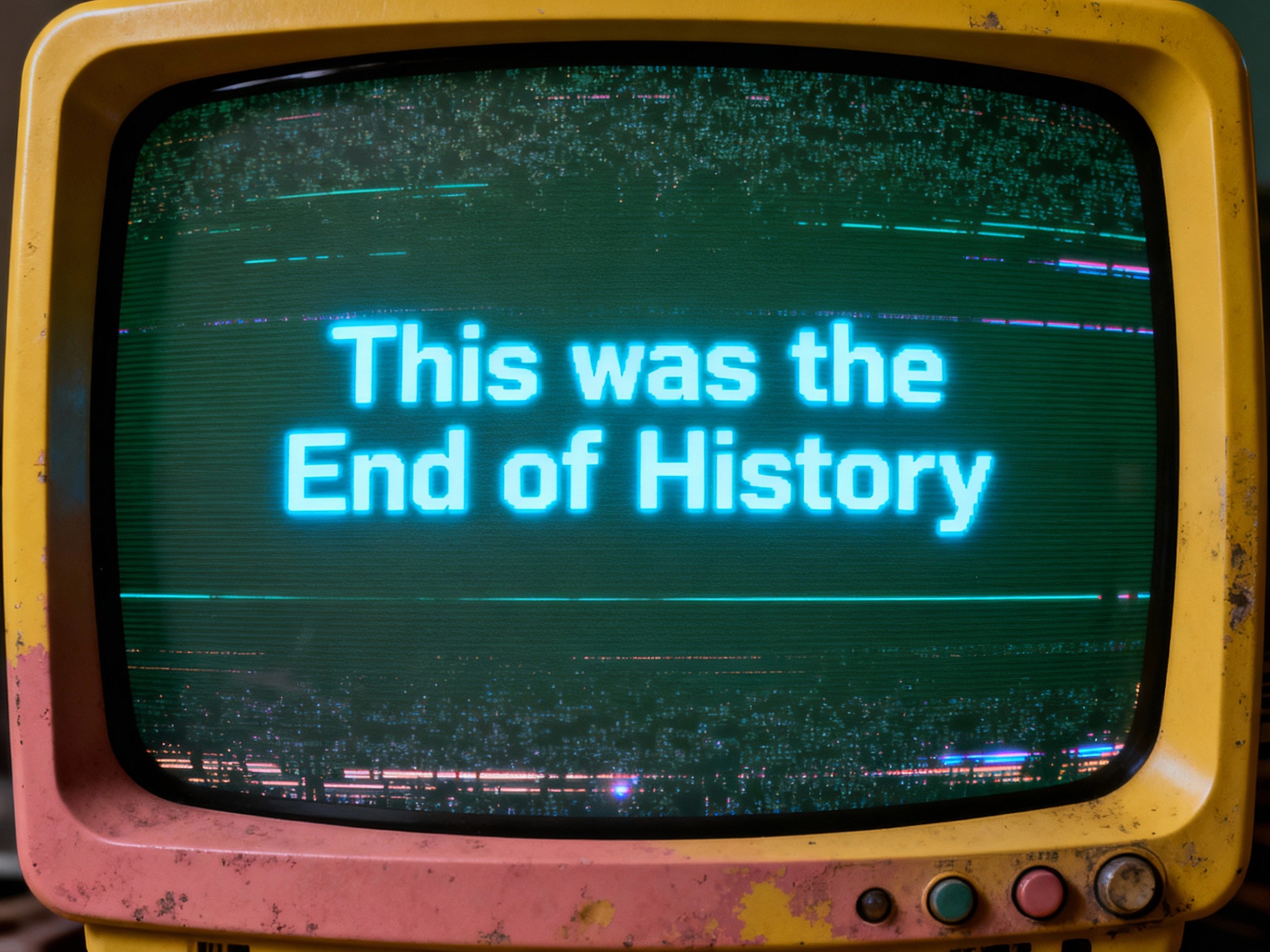
There was an optimism as well. It was the End of History. The battle of competing systems was over and authoritarianism was in retreat. The future was to be rational, free and prosperous. We just needed to work out the details. That lyric, “never been a better time than right now” landed like a kind of spiritual punctuation mark. The past had ended and the future was open. It was a call to action and one that was historically resonant. Postmodernism talks about the death of the author, where, once published, the intentions of the author evaporate: what becomes important is the text itself, the act of reading and how the reader interprets it. You could make the same case for the death of the songwriter. I bet the Red Hot Chili Peppers had no deep intention behind this lyric other than an expression of youthful freedom, other than it fitting in a kind of pop music nursery rhyme, in a simplistic and infantilised fashion. Yet, it still resonated and still does, for those who are listening.
They say that ‘nostalgia’ literally means ‘the pain from the old wound’. Looking back through Adam Curtis’ documentary definitely produced a kind of aching for me: pain from memory, pain from disorientation and pain from the awareness that something has gone, permanently. And that’s what the lyric makes me consider what it invoked: now is all we have.
Steven Pinker, in Enlightenment Now, argues that by virtually every quantifiable metric: health, wealth, literacy, democracy and life expectancy, the world is better than it has ever been. In many ways, he is right, but, as it was written in 2017, before Covid, before the world went into meltdown, you have to wonder whether life in 2025 is better than life in 2017. I honestly do not know. I don’t think anybody truly does know yet, although I do sense a backsliding. Still, it is certainly better now than it was in 1925, 1825, 1425, etc. Fewer people live in poverty. Violence has decreased. More people have access to education, medicine and civil rights than ever before. By those metrics, if progress is a graph, then we are riding its steepest upward curve.
But while these things may be statistically better, they also feel increasingly unmoored. We grapple with multiple paradoxes. We are more connected than ever and yet we are often lonelier. We have more access to information than ever, yet we seem to know less, and we certainly trust less.
The tools that we have are extraordinary, like AI, gene therapy and instant communication, but our foundations feel shaky. The “right now” is louder, faster and ever more fragile.
The lyric echoes a very old idea: the present is all we truly know. The past is memory and the future is only ever speculation. It might not even arrive, which is why the habitual use of “Insh’Allah” (God willing) in Arabic tells a truth with each time it is uttered (as does “Masha’ Allah” (as God has willed) uttered to marvel at something that God had seen fit to allow to come to pass). The only real moment is this one. Whatever is coming and whatever came before, now is where we act, where we give and take and love and fight and make meaning. In that sense, “never been a better time than right now” is a spiritual orientation, as well as a declaration of progress. We are asked to stake something on the moment because it is real and present.
In 1991, I suppose this made sense. There was still space, culturally and politically, for dreaming. Fukuyama’s End of History echoed in the background that the future would be a steady refinement of liberal ideals. Looking at this through a 2025 lens, this seems quaint.
If we look at that lyric now, it feels prescient and hollow at the same time. We do live in remarkable times. Medicine has leapt forward with mRNA vaccines and AI-assisted diagnostics. Communication is instant, global and largely democratic. There are genuine gains in human rights, especially for minorities and the growing visibility and destigmatisation of mental health. Technology offers solutions that were once inconceivable. But then all of this brings with it its own crises: the panopticon, misinformation, burnout, the deep uncertainty of AI’s role in the future of work and creativity and Anthony Kiedis’ awful moustache. I am of the generation where we considered the moustache a very terrible look. Oh, and there is also the small matter of countries moving towards a war footing.
The environment, too, tells a different story. In 1991, the climate crisis was an emerging concern. In 2025, it is our daily reality: fire seasons, flooded cities and displaced communities. This is a reality that so many still refuse to believe (anybody remember the pandemic-era movie ‘Don’t Look Up’?). The “never been a better time” is hard to see through severe climate transformation.
Economically, there has been both innovation and inequality. Technology has created new wealth, new markets and new access, especially to the global south. But there is intensified concentration to just a few companies and this has brought about an unprecedented transfer of wealth from the public to a few plutocrats. We will soon see the emergence of the trillionaire.
Politically, too, we are caught in a paradox. On the one hand, young people are more globally conscious and more organised. On the other, democratic institutions are eroding, misinformation is rampant and trust in media, governments and science, is fractured. Fukuyama’s End of History statement now looks more like a prelude to growing confusion.
“Never been a better time than right now” in 1991 felt like a rallying cry. In 2025, it feels more like a dare. Now is not necessarily better, but it is all that we have. The lyric, in its simplicity, reminds us not to wait. We should not be waiting for perfect conditions, for the fog of disorientation to lift a little, but it is the only place where change is possible and where decisions live. The past is gone, the future is uncertain, and we are where we are: ground that is flawed, burning and unstable, but it is the only ground that we stand in. It is the right now.
Thank you for reading,
Mark Gibson
Leeds, United Kingdom, July 2025
Originally written in
English